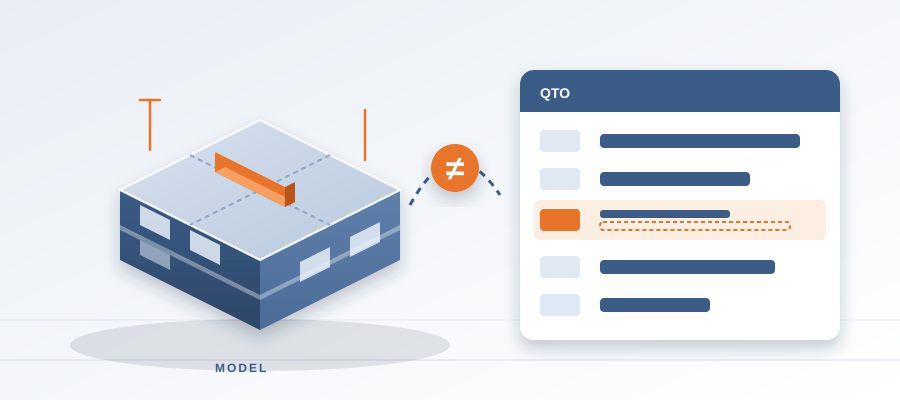
Your QTO Is a Lie. Here's Why.
The Number Was Right When You Made It
Many quantity takeoffs are wrong by the time they are printed. The estimator wasn't careless. The building keeps moving and the file you sent keeps sitting still. You export a schedule, the architect shifts a corridor, and now your bid prices a building that no longer exists. Nobody tells you. The number just ages out.
Quantity takeoff is counting and measuring what a project contains: doors, or linear feet of pipe. If you're asking what quantity takeoff in Revit is, the plain answer is that Revit already knows. The model is a database with geometry attached. Every wall, fitting and fixture is an object with parameters you can count. The takeoff already exists inside the file.
The trouble starts on the way out. Push that data into a PDF or a spreadsheet and you cut the count off from its source. The spreadsheet becomes a photograph of Tuesday. It can't know Wednesday happened. Every revision after export turns your bid into a historical document.

So estimators re-export and re-check. They keep a mental list of what moved since the last version and patch the numbers by hand. That reflex isn't a skill. It's a tax. It gets heavier on larger jobs and larger teams, and it never catches everything.
Here is the plain version. If your takeoff lives outside the model, it drifts the second the model changes. If it runs inside the model, it moves with it. BidLight keeps one live record of the project inside Revit and Navisworks, with cost riding on the same geometry the architect is editing right now.
Where Scope Slips Away
Scope escapes a takeoff in three places, and each one is a gap between systems. The first sits between the model and the export. Somebody forgot to reload a linked file. A workset was hidden during the last schedule run. Two versions of the same level exist and the schedule pulled from the one nobody is designing against. The count comes out clean and wrong. That is the worst kind of wrong, because nothing looks broken.
The second sits between the export and the pricing sheet. A line item gets combined, renamed or merged with a similar one. Part of the quantities land in a row that never gets carried into the final bid. Scanning won't find it, because the totals still look reasonable. You find it in the field, when the drywall crew runs out of board on level three.

The third sits between the last export and the day you submit. This is the expensive one. Design changes land in the middle of pricing, which is normal on any project worth bidding. Each change invalidates part of your work. Miss one and you bid a building that stopped existing last Thursday, then defend that number in a room full of people who can read the current model.
All three gaps are silent. A missing door throws no error. A stale wall type doesn't flag itself. The takeoff still totals, the bid still goes out, and the error only shows up as a cost. That is how a firm ends up bidding 1,100 doors on a model with 1,200, eating the difference, and then explaining it.
The fix isn't discipline. Discipline is what you fall back on when the process is broken. The fix is removing the export step, so there is no gap to slip through. Automated quantity takeoff from Revit means the count is never a copy. It is a live read of the same file everyone else is working in, so it can't be older than the model.
What Live Looks Like Day to Day
Say a mechanical engineer moves a rooftop unit four feet and reroutes the duct run feeding it. In the old workflow, that change waits in a queue. Someone has to notice it, re-export the schedule, update the ductwork quantities, adjust the insulation footage, reprice the fittings and push the numbers into the bid. Best case, that takes hours. Real case, it happens Thursday, if it happens at all.

In a live workflow, the model is the takeoff. The duct run is shorter or longer the moment the designer commits the change. The labour and material tied to those linear feet move with it. No export. No schedule refresh. No one in the middle deciding whether the change matters. You look, and the number is current, because it is a read of the file, not a memory of it.
How do you take quantities in Revit against a live source? You open the project and point BidLight at the model. Two AI models read the geometry and the metadata together, element by element, and sort what they find into BOQ line items. They hit 86% accuracy on classification. That clears the tedious first pass and leaves the estimator on what they're good at: judgment on the 14% that needs a human eye.
Pricing isn't a separate exercise either. Line items pull from a database of roughly $30,000 plus Craftsman, 1Build and RSMeans. The labour, equipment, material and time costs you see come from current rates, not from a cost book someone updated last spring. You get the estimate in minutes, and it updates in real time when the design changes. Finding out what changed between two exports takes 15 minutes instead of a 90-minute meeting.
And none of it freezes. If the door moves, the takeoff moves with it. That's the whole idea. The count and the cost share the same live source.

Why This Wins Bids Instead of Just Saving Time
The obvious win is hours. Teams that stop re-exporting and re-checking put those hours back into the work that wins jobs: reading the scope, questioning assumptions, finding the angle nobody else priced. Pricing is per licence, with unlimited projects on every plan. Basics is $260 a year.
The bigger edge is defensibility. When a client asks why your number is what it is, you open the model and show them. That wall, that footage, that rate, that source. There is no gap between what you say and what the model holds, because there is no second version of the truth. That turns a bid conversation into a trust conversation, and trust gets you on the shortlist before price comes up.
It also changes what you can sell. Early design estimates stop being a favour you give away to stay in the running. They become a service you can bill for. A client at concept stage asks what it will cost and what happens if the design changes. You can answer in minutes instead of days, and price the answer as a deliverable. Firms working this way report win rates around 35% higher. They show up with numbers, not a promise to get back to someone.
There is a reputation angle too. Brand equity usually comes down to consistency: the airline that lands on time, the tool that never fails on site. In AEC, that's being the firm whose numbers hold. When your takeoffs are live, your reputation stops depending on whether this month's estimator was careful. It depends on the system, and the system doesn't get tired.

BidLight also does the work with you when you want that. Our done-for-you BIM services cover execution plans, 4D and 5D, and fabrication detailing and spooling. Some firms want the software and run it themselves. Some want the output without the staffing question. Either way the estimate comes from the model, and the model is the record.
What to Do Monday Morning
Begin with one active project, not the whole portfolio. Pick something mid-design where changes are still landing. That's where drift shows up fastest and the value is easiest to see. Point BidLight at the model, let the classification run, and compare the output against the takeoff you already have. Don't look for agreement. Look for differences. Every difference is a place your old process was quietly losing scope.
Then change one habit. Stop exporting to price. The export is the moment the takeoff starts dying. Keep the number attached to the model and most of the downstream checking disappears on its own. Estimators don't enjoy copying and pasting between files, and they don't enjoy redoing work they already did. Give them a source that stays current and the job becomes what they trained for.
Finally, spend the time you save on something other than catching up. When you find the changes in 15 minutes instead of 90, you can bring numbers to the first client meeting instead of the third. You can price a design option while the client is still deciding. You can answer the question in the room instead of promising a follow-up. That is where the win rate lives. Not in the software, but in what the software lets you do in front of a client.

The takeaway is short. A takeoff printed on Tuesday describes the building that existed on Tuesday. Stop bidding on yesterday's truth. Keep one live record of the project inside Revit, let the cost ride on the same model, and the numbers you defend will be the numbers that are there.