Your Coordination Is Still Running Like It's 2019
The Gap Between Your Process and the Job Site
Pull up the folder you coordinated from last month. Now ask when the markups inside it were last checked against the model by a human. For a lot of AEC firms, the plain answer is a few weeks ago. The folder got copied forward, the issue list got updated whenever someone remembered, and the whole thing looks fine on the surface because it always looks fine on the surface.
Here is what moved while that folder sat still. The architect revised the levels. The mechanical team rerouted a riser. The structural model changed three weeks ago and the ceiling trade never heard about it. Those are not rounding errors. A clash that sits 47 days can burn $28,000 in idle field labor, and that is one clash.

The way this hurts is quiet. You coordinate the job with last month's markups. The picture looks right. Work starts. Everyone is happy for about three weeks. Then the crew hits the beam, the electrical foreman calls, and the real conflict shows up in the field where nobody was looking during the coordination meeting.

You already know this feeling. It is the one you get when a design change rolls through and you have to rebuild half a comparison from memory. The problem is not that you are careless. The problem is that the source of truth for the issues was never connected to the source of truth for the model. One lives in email and Teams. The other changes every week.
The fix is not a bigger spreadsheet. It is refusing to coordinate from a snapshot. The record has to ride on the same model the design rides on, so the picture in the coordination meeting and the picture in the field are the same picture.
Why Teams Keep Patching, and Why It Costs More Than It Saves
Teams that know their process is stale do the only thing that feels rational. They add meetings. A weekly sync here, a Friday review there, a standing call for the trades that burned them last time. It is a defensive move, and it is understandable.
But more meetings are a tax you pay every single week, including the weeks nothing changed. A team that adds a 90-minute meeting to cover uncertainty loses the time to solve the problems, and it still misses the changes that happened between meetings. You get the worst of both outcomes at once.


The deeper cost is credibility. When your status is a guess wrapped in a meeting, you cannot explain it. A GC asks why the mechanical area is behind, and the plain answer is that it felt about right. That is not a defense. It is an admission.
There is a version of this where you stop hedging and start knowing. When status comes from the model instead of a markup that predates the last three revisions, you do not need another meeting. You need to point at the record. That changes the conversation from haggling to reviewing.
This is the difference between a coordination process that stores updates and one that keeps them current. Storage is cheap and it is everywhere, including the shared folder you set up years ago. Currency is the part that protects your schedule.
What a Live Record Looks Like Inside the Model
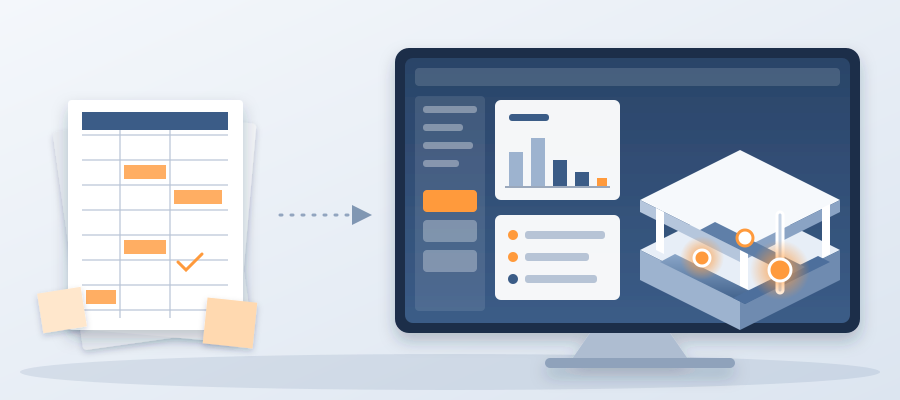
BidLight keeps one live record of the project inside Revit and Navisworks. You publish from the model. Every publish becomes a versioned snapshot with its own files, author and milestone, and any two revisions compare element by element. The record is not a separate document that trails the model by two weeks. It is the model, versioned.


The comparison is grouped by category: structural, MEP, envelope and interior. That matters because finding the change is the slow part of any coordination cycle. Someone has to look at a shape, decide what moved, and work out who is affected. When the record does that grouping, your coordinator is reviewing and following up instead of building from a blank sheet.
Issues are pinned to the elements they concern and carry the sheet and the revision they came from. Closing one requires proof: a screenshot, a tagged user and the model commit that fixed it. So when you ask whether a problem is solved, the answer is on the element, not in someone's inbox.
That combination is the whole point. The comparison gets you the change fast. Pinned issues keep it honest as the model shifts under it. The review that took 90 minutes in a meeting now takes about 15 minutes, and the 15-minute version is clearer than the 90-minute one was.
For firms, this turns a cost center into something you can show clients. You can answer a question during the coordination meeting, before the conversation moves on. You can review three schemes instead of one. You can bill for coordination because the output is worth something.


## Reading the Project the Way You Read a Model Diff
Coordinators already know how to watch for signal. You diff a model and you see what moved. You look at a section change and you know what it does to the trades downstream. That instinct is the same one behind a good project view: something changed, several people need to react, and the useful question is what caused it and whether it is structural or noise.
The same discipline applies to your team. When one trade falls behind on its issues, that is not noise. It is a change in the schedule that touches every trade after it. If your process cannot show it, you are flying on instruments that stopped working.
Most firms never look at this, which is part of why schedule leaks. Nobody is assigned to watch ownership the way somebody watches the model. It is everyone's problem and no one's job. The daily 6am digest and the Problem Solver Index do that watching for you, continuously, without a meeting.
The related skill is keeping owners and developers confident. They worry about surprises. When you show up with a picture that is current and explainable, and then show them the next revision the next day with the same clarity, you are not managing a crisis anymore. You are managing trust.


That is the strategic reason to care about a current record. It is not just about this job. It is about being the firm the client calls first next time because your project held up.
Your Record as a Service You Can Show
The firms getting the most out of a live record are not just coordinating better. They are using the record as part of the service. Early design questions get answered in the room because the answer is fast and grounded. Three schemes get compared in an afternoon. A client asks what happens if we move the core, and you tell them before the coffee goes cold.
That is real value that most AEC firms give away. You already do the thinking. You just do it slowly and for free, or you do it fast and wrong. With the record riding on the model, you can do it fast and defensible.
The coordination software market is moving the same direction. Buyers expect faster answers and auditable records. Firms that can produce them in the room keep the schedule. On the hyperscale programme, BidLight helped save 18,000+ hours and $12.3M in cost. That is what happens when the record stops being a guess.


Plans run from Basics at $260 per licence per year to Max at $590, with custom Enterprise pricing and unlimited projects on every plan. Beyond the software, BidLight does done-for-you BIM work: execution plans, 4D sequencing, fabrication detailing and spooling. If you want the whole function handled, that is on the table.
The pitch is plain. Stop chasing scattered updates across email, Teams and 47 versions of the same markup. Catch the clash in the model for about $50, not in the field for $5,000 to $50,000. One live record of the project inside Revit and Navisworks, with every change compared and every issue closed with proof.