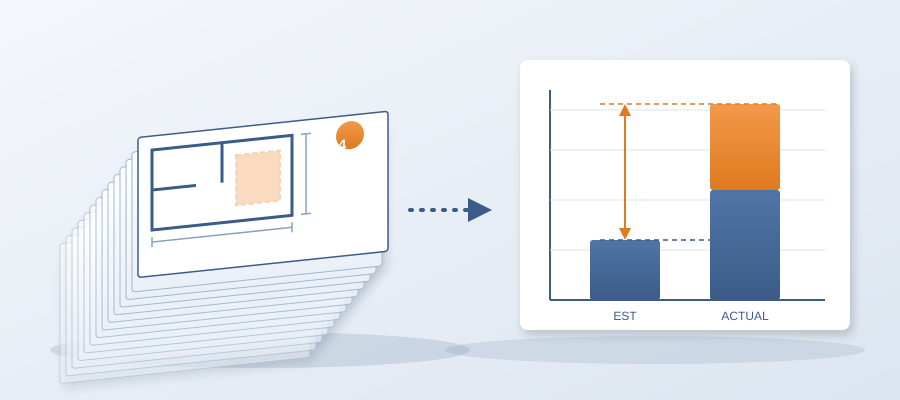
Your design changed 14 times. Did your estimate?
The Cost of a Moving Wall: Why Traditional Estimating Falls Short
In the AEC industry, change is constant. A wall moves, a door swaps, a duct reroutes, these are everyday events. But each one carries a financial ripple. Traditionally, estimators catch up by re-exporting models, redoing takeoffs, and sending updated spreadsheets. That process takes days, sometimes weeks. By then, the design has shifted again, and you're chasing a moving target. The result? Your estimate is outdated before it even reaches the client.
Consider a simple scenario: You're pricing a commercial build. The architect decides to move a partition wall six inches to accommodate a new layout. That change might affect drywall quantities, electrical outlets, baseboard lengths, and maybe the HVAC layout. Each of those has labor and material costs. Without real-time tracking, you might not realize the impact until you're deep into the project, and then it's a painful change order or a hit to your margin.

The traditional estimating workflow is reactive. You wait for the final model, then you price it. But design is iterative. Changes happen weekly, sometimes daily. If you wait until the end, you lose the ability to inform early decisions. You become an order-taker, not a partner. Worse, you risk submitting a bid that doesn't reflect the actual current state of the design, which leads to either a losing bid or an unprofitable job.
Now, imagine a world where you see the cost impact the moment the architect clicks 'move.' That's the promise of real-time estimation. With BidLight, you don't redo the takeoff. Two AI models read the Revit model directly, update labor, material, and equipment costs, and give you a fresh number in minutes. No waiting, no rework. You can have a defensible estimate that aligns with the design as it is today, not as it was last week.

This isn't about being faster; it's about being smarter. When you can show the client the cost consequence of a design change in real time, you become a trusted advisor. You win more work because you're providing value beyond just a number. You're helping them make informed decisions that keep the project on budget. That kind of insight is what separates top-tier estimators from the rest.
The Real-Time Estimation Advantage: How BidLight Delivers
BidLight's platform is built for the way modern design teams work. It lives inside Revit, so you don't have to switch tools. You export your model, and two AI models take over. They read the geometry and metadata, classifying BOQ line items with 86% accuracy. They pull current pricing from a database that costs roughly $30,000 a year to maintain, plus RSMeans, 1Build, and Craftsman. The result is a detailed cost estimate covering labor, equipment, material, and time.
The real gain is the real-time update. When the design changes, you simply refresh the model, and the estimate updates automatically. No re-export, no manual adjustments. The numbers change, and you see the budget impact instantly. This means you can explore cost scenarios without committing to a full re-estimate. 'What if we move the lobby?' becomes a question you can answer in real time.

The pricing database is a significant asset. Because that database costs roughly $30,000 a year to keep current, BidLight ensures you're not relying on outdated unit costs. The inclusion of industry-standard sources like RSMeans gives you credibility when defending your numbers to clients or stakeholders. You can trust that your estimate reflects real-world costs, not gut estimates or dusty spreadsheets.
Beyond the software, BidLight offers done-for-you BIM services. If you're overwhelmed, our team can write execution plans, handle 4D/5D, and take on fabrication detailing and spooling. This is a full-service approach that saves you time and leverages expertise you might not have in-house. It's like having an extra estimator on call, without the overhead.

The bottom line: real-time estimation is not just a feature; it's a strategic advantage. It allows you to bid more accurately, respond faster to design changes, and turn estimation from a back-office task into a strategic service you can bill for. You're not just computing costs; you're providing insight that drives better design decisions.
Making Estimation a Service: Turning Early Numbers into Billable Work
One of the biggest changes BidLight enables is the move from estimation as a cost center to estimation as a revenue generator. Traditionally, architects and engineers offer early estimates as a courtesy, hoping to win the design contract. But with real-time cost feedback, you can charge for that value. It becomes a service you can bill for at the pre-construction stage.
For example, you could offer a 'schematic cost assessment' package. For a flat fee, you'll provide cost updates at each design milestone, helping the client stay on budget from day one. The client sees tangible value: they're not waiting until the end to discover the project is over budget. You're giving them control, and that's worth paying for.

This model also fosters stronger client relationships. Instead of being the bearer of bad news when invoices land, you're a proactive partner flagging cost overruns early. You're involved in the decision-making process, not just the aftermath. That shifts the dynamic from transactional to collaborative, which often leads to repeat business and referrals.
From a strategic perspective, real-time estimation helps you position your firm as tech-forward. Clients are increasingly looking for partners who use modern tools to improve efficiency and accuracy. By adopting BidLight, you're sending a signal that you're invested in delivering the best possible outcomes. This can be a differentiator in a competitive bidding environment.

Finally, consider the internal benefits. When your team has access to real-time cost data, they can make better decisions about design alternatives. You can evaluate trade-offs on the fly, 'If we use a different material, does it stay within budget?' That kind of agility is invaluable in a fast-paced industry. You're not just estimating costs; you're managing them proactively.