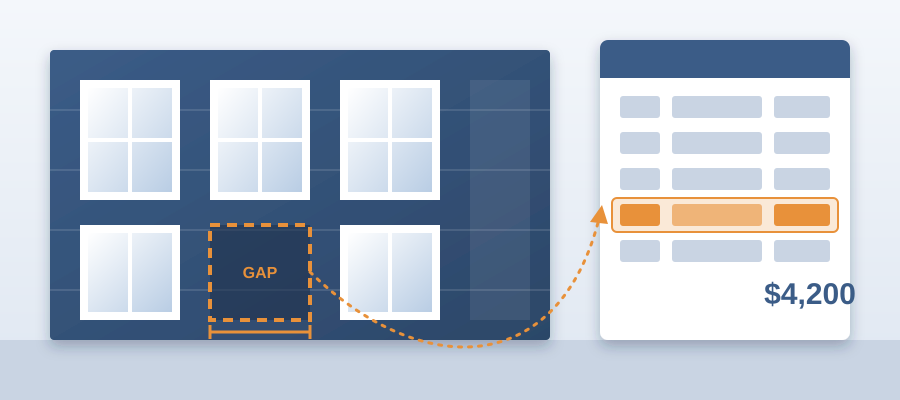
You put $4,200 of windows in a wall. The schedule said gap. The gap said reorder.
The $4,200 Window Shift That Nobody Saw Coming
You put $4,200 of windows in a wall. The schedule said gap. The gap said reorder. Here is how that happens. A single window moved six inches on the architect's model. The change was invisible to the eye. The wall looked the same. But the schedule told a different story: the window now overlapped a structural column. The gap in the opening no longer matched the rough-in. So the team had to reorder the window assembly, pay for the new units, and eat two weeks of delay. All because one geometry change went unnoticed until construction.
That window was not exotic. It was a standard double-glazed unit with a low-E coating, about $2,100 per window. Two windows sat in that wall, so the total was $4,200 in materials alone. Add the labor to uninstall the already-set frames and reinstall the new ones, plus the rental costs for the lift that had already moved on to another site, and the true cost probably cleared $7,000. The schedule slip pushed the curtain wall subcontractor into overtime. The general contractor had to re-sequence the interior rough-ins. Nobody caught it because the estimate lived in a spreadsheet that nobody updated after the last design review.

The old way is to re-take off the model manually. That takes days. In a deadline crunch, the team might skip the re-takeoff entirely, trusting that the changes were minor. That is how $4,200 slips through. That is how delay becomes a change order and the change order becomes a claim. When the design changes, the estimate should change with it. When the wall moves, the dollars should move too. That is the gap.
The good news: you do not have to live in that gap. With an AI estimation platform that reads the model the day it changes, you see the cost impact in minutes. You do not wait for someone to open a spreadsheet and re-measure. The system re-classifies the line items, re-pulls pricing from a current database, and tells you the new number before the end of the day. That small window shift becomes a one-line note in an email. The window moved, here is the cost impact. You decide whether to adjust the design or the bid, not whether to file a claim. That is how you protect your margin and your schedule.

Why a Revit Material Takeoff vs Schedule Mismatch Is a Silent Budget Killer
The root issue is that Revit's material takeoff and its schedule do not always agree. A Revit material takeoff counts the physical materials in the model. A Revit quantity schedule counts the elements as they are scheduled, often with different parameters. When a window moves, the material takeoff might still show the same window. But the schedule, which reads the opening's dimensions and rough-in requirements, might show a discrepancy. That mismatch is exactly where the $4,200 disappears. The takeoff says the window is there. The schedule says the opening is too big or too small. So the estimator uses one, the fabricator uses the other, and the gap shows up in the field.
Now, imagine your team relies on a static spreadsheet that was exported from the model two weeks ago. The model has changed 14 times since then. Each change altered the geometry, but nobody re-exported. The spreadsheet still says the window is 3'0 x 5'0. The model says it is 3'6 x 5'0. The schedule says the header needs to be taller. But your estimate is based on the old size. When you buy the windows, they are too short. You either send them back or you modify the framing. Either way, you eat the extra labor and the delay.

That mismatch is not rare. On a typical commercial project, the model changes many times between design development and construction documents. Each change can affect dozens of line items. A door swings the other way, a duct reroutes, a window shifts. If you re-take off the model manually each time, you spend days. So you skip it. You rely on the last export. That is the silent budget killer. It does not announce itself. It just shows up as a backcharge or a claim months later.
An AI-powered estimation tool that lives inside Revit solves that mismatch by comparing each revision against the last, element by element. It shows which elements changed and reprices the classified line items in minutes. The report shows you exactly which items changed, how the quantity changed, and what that means for the budget. You do not have to wonder if the takeoff is current. It is current because it runs on the latest revision. That means you can walk into a meeting with the owner and explain the cost impact of a design change with confidence, not with a guess. When you have that level of clarity, you can negotiate from strength, not from panic.

Turning Early Estimates into a Billable Service
The window shift scenario is not just about avoiding rework. It is about creating a revenue stream. Every time you respond to a design change with an updated price in hours, you are demonstrating a capability that clients will pay for. They are already paying for design; they are already paying for construction. But they are not used to paying for quick, reliable cost advice during the design phase. That is an opportunity. You can package your real-time estimating as a service: Schematic Cost Advice or Design Impact Analysis. Charge a flat fee or an hourly rate for a subscription that gives the client access to your estimator for a monthly retainer. For example, a small architecture firm might offer a flat monthly fee that covers two design revisions a month.
When you present this to your own leadership or to clients, you need to show the value. Start with the avoided cost: a $4,200 window mistake would have wiped out the profit on a small job. Then show the margin you add. A fee for design-phase cost advice, repeated across every project you run in a year, is real money that drops straight to your bottom line. And the time comes back too: case-study clients saved 680 hours of estimator time that they reinvested in winning more bids.

Case-study clients saw a 35% higher win rate after they started delivering estimates in a day instead of a week. They did not change the quality of their design or their construction drawings. They just made the estimating process transparent and immediate. That transparency built trust. Trust won bids.
To make this work, you need the right tools. BidLight, for example, lives inside Revit and updates your estimate in real time when the model changes. Two AI models read the geometry and metadata to classify line items with 86% accuracy, and pricing comes from a database that costs roughly $30,000 a year to maintain, plus industry standard sources like RSMeans, 1Build, and Craftsman. That means your numbers are always defensible. You do not have to second-guess a unit price because the database is current. You can sit across the table from an owner and say, Here is what the change costs, and here is where that price came from. That credibility is priceless.

The old fear was that quick estimates mean less accurate ones. Not anymore. With AI, you can have both speed and precision. And that combination turns a necessary chore into a competitive advantage. You stop being the firm that chases updates and become the firm that leads with cost intelligence. That is a service clients will pay for, and a reputation that wins more work than any marketing campaign.