Kickoff Is Just the Beginning.
The Job That Starts Well
You start a job on a clean model. The owner shakes your hand. Your team is pumped. Then the site conditions shift. The owner tweaks the layout. Your schedule starts to slide.
Without a way to track model updates, you are flying blind. The rebar spec changes. The duct layout moves. Each change looks small on its own, but they pile up. By the time you see the damage, the work is already in the ground.
Most teams find out about rework when the crew is standing idle. That is too late. You have already committed labor and materials. You cannot go back to the owner because you did not catch it early.

Say the rebar spec changes in a model revision and nobody flags it. You do not see it until the pour is stopped, because the coordinator was already on the next set of drawings.
That is the real fight after kickoff. It is not about the first meeting. It is about making sure the job actually runs to plan.
BidLight fixes that. It compares every model revision the day it is published, not when the problem lands on site. You get a job that runs to schedule, not one that punishes.
Why Traditional Tools Fail You After Kickoff
Most coordination tools do one thing well: they review a static model. You run a review, log some issues and send the package. But the model never stays static. The design changes, and your log goes stale.
Traditional tools do not connect to the live model. Every revision needs a manual update, which means hours of rework. You might redo the comparison, but by the time you finish, the model has changed again.
That gap between what was coordinated and what gets built eats your schedule.

Some teams try to solve this with multiple tools. They export the model, paste it into a spreadsheet and note changes by hand. It is slow, error-prone and gives you zero real-time visibility.
Others rely on weekly or monthly coordination meetings. That is better than nothing, but it is still reactive. You are looking in the rearview mirror.
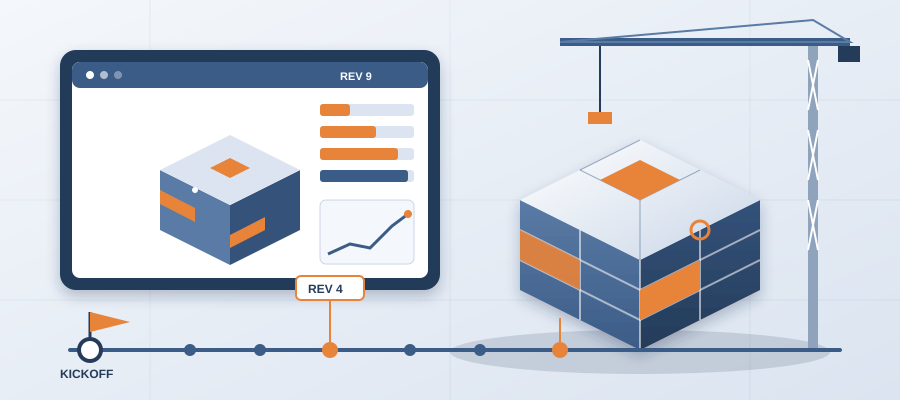
What you need is a tool that lives inside Revit and Navisworks and records the change the moment the model is published. That is BidLight. Each publish is a versioned snapshot with its own files, author and milestone. Any two revisions compare element by element, grouped by category: structural, MEP, envelope, interior.
You see what changed in about 15 minutes instead of a 90-minute meeting. When the design changes again, the next publish updates the comparison. That is the difference between flying blind and flying with instruments.
The Tracking That Keeps Your Schedule Intact
Here is how tracking works day to day. You publish your Revit model to BidLight. Within minutes, you have a snapshot and a comparison against the last milestone. But the story does not end there.

The owner decides to move a wall. The architect updates the model. BidLight catches the change and lists the affected elements. You see the impact immediately, before the change order is even drafted.
This is not about producing a new package. It is about tracking against the original. You see the delta between what was coordinated and what the current model says. That delta is your early warning system.
Now run the same change through the issue flow. The spec changes in a model revision, and the affected elements are pinned the same day. You go back to the owner with the exact list before any work is done.
That conversation is much easier before the work is in the ground. You keep your schedule.
The hyperscale programme shows what that looks like at scale: 18,000+ hours saved, 8,900+ issues resolved and $12.3M cost saved. Those hours go back into the job.
That is the real win. Not just the start, but the ability to defend your record and keep the job on track.

What to Look for in Coordination Software
If you are in the market, ask yourself what happens after kickoff. Does the tool track changes? Does it compare revisions? Does it give you real-time visibility?
Most tools do not. They are built for the review phase, not the long fight after. That is why so many teams lose time and money on jobs that started clean.
A good tool should integrate with your modeling software. For most AEC firms, that means Revit and Navisworks. It should read the model directly, not make you rebuild lists by hand.
Proof matters. In BidLight, an issue closes only with a screenshot, a tagged user and the model commit that fixed it. That means a closed issue stays closed, and the same problem does not come back on site.
Accountability is another factor. The daily 6am digest tells each owner what they hold. The project view shows who is behind while there is still schedule left to recover. You can see it per person through the Problem Solver Index.

Cost is a consideration too. BidLight is priced per licence, from $260 a year for Basics to $590 for Max, with custom Enterprise pricing. Every plan includes unlimited projects, and AIA members get discounts of up to 29%.
But the real return is in the hours saved and the rework avoided. A clash caught in the model costs about $50. The same clash found in the field costs $5,000 to $50,000. One avoided overrun pays for the software many times over.
Turning Coordination Into a Service You Can Offer
Most teams treat coordination as a necessary evil. They squeeze it in around everything else. BidLight flips that. It turns coordination into a service you can run well and offer to others.
With BidLight, you can keep a clean record from the first publish. That is valuable to owners and architects who need clarity on what changed before they commit to the next phase.
You can also lean on done-for-you BIM services: execution plans, content and design development, fabrication detailing and spooling, 4D sequencing and as-built modelling. You get the benefit without growing your team.
The tool makes it possible because it is fast. You publish the model, get the comparison in minutes, and present it in the same meeting. No more "I will get back to you next week."

This also positions you as a strategic partner, not just a vendor. You are helping the team make informed decisions. That builds trust and leads to more work.
BidLight does not stop at kickoff. It helps you keep the job on schedule, close issues with proof and keep the field from paying for what the model could have caught.