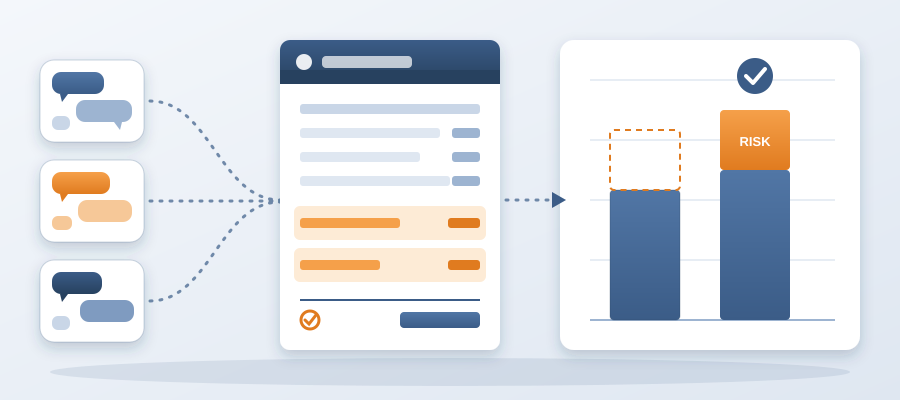
Win More Bids by Pricing Risk, Not Just Materials
The Illusion of Material-Centric Bidding
For too long, the construction bidding process has been dominated by a narrow focus: the cost of materials and direct labor. We meticulously tally every pipe, wire, and brick, assuming that a precise material takeoff equates to a winning bid. This approach, while understandable due to its tangible nature, fundamentally misses a huge chunk of project costs, the costs associated with uncertainty and potential problems. These aren't minor line items; they represent significant financial exposure that can erode profits or, worse, lead to project failure if not accounted for.
Think about a typical takeoff. It's an exercise in counting and measuring what's supposed to be there. But construction is inherently dynamic. Designs evolve, site conditions present surprises, and unforeseen clashes between trades emerge with alarming regularity. Ignoring these inherent risks because they're hard to quantify is like a ship captain navigating the open sea without accounting for weather patterns or potential storms. You might have a perfect inventory of your supplies, but a single unforeseen event can sink the entire voyage.

This reliance on material costs alone creates a false sense of security. It leads to bids that are technically accurate on paper but dangerously vulnerable day to day. When a coordination issue arises late in the game, or a subcontractor's schedule slips, the direct impact on the budget can be catastrophic. The profit margin, already thin in many projects, evaporates quickly when these unpriced risks materialize. It's a gamble, and it's one that smarter firms are starting to avoid.
The problem isn't a lack of awareness about these risks; it's the lack of a practical, reliable method to measure them. Estimators are skilled professionals, but they're often left to make educated guesses about coordination complexity or the likelihood of rework. These guesses are often informed by experience, but they lack the data-driven precision needed to confidently price them into a bid. This is where traditional methods hit their ceiling, leaving a critical gap in the bidding process.

Introducing Risk-Based Estimation with AI
What if you could move beyond just counting materials and start pricing the unknowns? That is the shift a model-based platform like BidLight makes possible. Instead of relying on guesswork, you work from the data already in your BIM model. BidLight tracks every model change and every clash or issue between revisions, pinned to the elements they concern. When ductwork runs into a structural beam, the issue sits on those elements with the sheet and revision it came from, so you can see exactly where coordination risk is piling up.
Take a large commercial building. Compare any two revisions element by element and you can see, category by category (structural, MEP, envelope, interior), where the design keeps moving and where open issues cluster. Dense zones where MEP, structural, and architectural work intersect show up as the places that keep changing and keep collecting issues. That record gives you a reasoned basis for a coordination allowance, instead of an unpriced contingency or, worse, an out-of-pocket expense.

This isn't about adding a generic percentage for risk. It’s about pinpointing where the risk lies and how much it’s likely to cost. Say plumbing, HVAC, and fire suppression all meet in one ceiling void. Traditional methods might add a general 'high complexity' note. With BidLight, you see the specific elements involved, the issues pinned to them, and how often they changed between revisions. Because the estimate runs on the same model, you can price the extra fabrication, installation, and testing time for that zone and include it in your bid with confidence. Risk stops being an abstract worry and becomes a concrete cost.
This proactive approach fundamentally changes the estimator's role. It shifts from merely reporting existing design elements to actively uncovering potential project pitfalls. You're no longer just a calculator; you're a risk manager. The ability to present a bid that explicitly accounts for coordination challenges, potential rework due to design evolution, and schedule impacts provides a level of transparency and confidence that clients appreciate. It demonstrates a deeper understanding of the project's complexities beyond the surface-level material count, positioning your bid as the most realistic and well-prepared option.

Integrating Risk Intelligence into Your Workflow
Adopting AI for risk-based estimation isn't just about acquiring new software; it's about evolving your entire bidding strategy. It requires a shift in mindset from focusing solely on the 'what' (materials) to understanding the 'how' and 'what if' (complexity, clashes, potential rework). The first step is integrating these AI tools directly into your existing Revit workflow. BidLight runs inside Revit and Navisworks and publishes straight from the model, so your estimators don't need to learn new modeling software.
Once the data is extracted and analyzed, the insights need to be clearly communicated. This involves not just the final number but also the rationale behind it. When you present a bid that includes a specific line item for 'complex coordination in OR suite ceiling,' you're providing value beyond a simple dollar amount. You're showing the client you've done the deep dive, understood the potential challenges, and have a reasoned approach to managing them. This transparency builds trust and differentiates your bid significantly.

Also, this approach can become a billable service. Many firms offer early-stage cost estimating and feasibility studies. By incorporating sophisticated risk analysis into these early services, you can provide clients with a much more accurate picture of project costs from the outset. This not only generates revenue but also positions you as a strategic partner, helping clients make informed decisions before significant design investment occurs.
Ultimately, embracing AI for risk pricing allows you to move beyond competing solely on the lowest material cost. You start competing on intelligence, foresight, and the ability to deliver projects predictably and profitably. It's about ensuring that every bid you submit is not just a price, but a promise backed by data and a deep understanding of the construction process.
