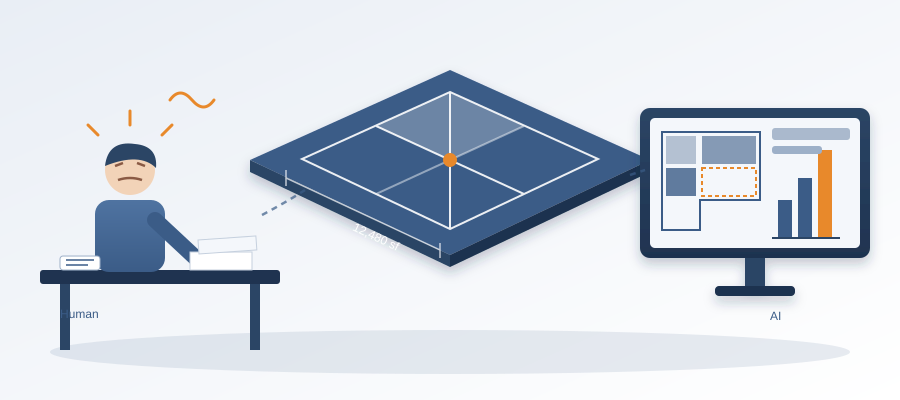
The Headache Nobody Wants to Hire For
Your job postings changed and nobody sent the memo.
Search for estimator, quantity surveyor, or BIM coordinator openings right now. Not last year's, this month's. You'll see a line that wasn't there before: experience with model-based takeoff or cost estimation software. A few years ago it was a nice-to-have at the bottom. Now it's moving up, and on more listings it's a hard requirement.

This isn't a guess. It's what happens when a role gets too expensive to fill the old way. A firm hiring an estimator today is hiring someone who can turn a design change into a defensible number before the next coordination meeting, not someone who spends three days walking a set of drawings with a highlighter. The job description hasn't been renamed. But the work behind the title has shifted, and the posting is catching up.
The math is simple. Manual takeoff on a mid-size commercial project can eat 40 to 80 hours of a senior estimator's time. Then the design changes twice during preconstruction, and the count starts over. Firms can't keep paying senior rates for repetitive counting when that person could be reviewing scope gaps or talking to subcontractors. So the requirement changes: instead of who can count fastest by hand, they ask who can read a model and trust the numbers it produces.

The hard part for experienced estimators is that this shift feels like a threat. It isn't framed that way in the posting, but it lands that way in the inbox. If the job now wants Revit-based cost tool fluency instead of manual takeoff years, where does that leave you? The rest of this answers that, and the answer is better than most expect.
This Was Never AI vs Human Estimator. It Was Slow vs Fast.
Frame this as AI vs human estimator and you'll misread the whole shift. Nobody is hiring a model to replace a person in a scope review. Nobody asks an algorithm to argue with a subcontractor. What firms are replacing is the slowest part of the estimator's week: manual counting, cross-referencing sheets, hours checking that a duct run on page 12 matches the schedule on page 40. That work was never the valuable part of the job. It just consumed the most hours.

Firms aren't trying to reduce estimating errors by removing the estimator. They're reducing errors by removing the manual step where errors creep in. A missed quantity on a hand takeoff doesn't announce itself. It sits quiet in a spreadsheet until the bid goes out low or change orders pile up. Model-based tools catch that differently because quantities come straight from the geometry instead of someone's read of a 2D sheet at 4pm on a Friday. That's not a knock on the estimator. It's the limit of counting by eye.
That's where BidLight fits into the hiring conversation, even though it's a cost tool, not a recruiting one. Our tool reads a Revit export directly and classifies BOQ line items with two AI models that read geometry and metadata, hitting 86% accuracy. It pulls pricing from a database that costs roughly $30,000 a year to maintain, plus RSMeans, 1Build, and Craftsman, so numbers aren't guesses from memory or last year's bid. An estimator who works inside that system isn't doing less thinking than one doing manual takeoff. Same thinking, applied to numbers that update when the design does, instead of numbers already stale when the takeoff finished.

That distinction matters because it changes what a firm hires for. They aren't hiring someone to replace judgment with a tool's output. They're hiring someone who can read what the tool produces, catch when it looks off, and turn that into a bid or client conversation fast enough to matter. That's a harder skill than manual counting, not easier, even though it takes a fraction of the time. The job posting just hasn't found the right words, so it says Revit-based cost tools and leaves the rest implied.
The Estimator Firms Fight Over Looks Different Now
Take two candidates. One has twelve years of manual takeoff and can walk drawings faster than almost anyone. The other has four years of experience but two of those years inside model-based cost tools, exporting Revit models, reviewing AI-classified line items, adjusting pricing assumptions against a live database. Five years ago, the first wins that interview. Today, more firms lean toward the second, and job postings show it in plain language.

That's not because experience stopped mattering. It's because the kind of experience that matters changed. A firm evaluating candidates asks who can produce a defensible number in hours instead of days, and who can re-run that number when a client asks for a design change without starting the whole takeoff over. The candidate who spent years on manual counts is skilled at something the firm needs less every year. The candidate who spent less time overall but inside model-based workflows is skilled at exactly what the firm sells to its own clients: fast, credible numbers that hold up.
For any estimator or BIM coordinator wondering where they land, the honest advice is straightforward. Manual takeoff skill isn't worthless, and it won't be overnight. But it's no longer the skill that gets your resume pulled. Learning to work off live model data, understanding how a tool classifies and prices a line item, knowing when to trust a number versus double-check it, that combination makes a firm fight to hire you instead of phasing your role out. The people who make that shift early aren't competing with Revit-fluent junior hires two years from now. They're already the hire everyone else is trying to become.

BidLight exists for exactly this transition. Export a model, get labor, equipment, material, and time costs back in minutes, and watch numbers update as the design moves instead of re-running a manual count every time a wall shifts six inches. BidLight is priced per license, from Basics at $260 a year ($30/month) to Max at $590 a year ($69/month), with unlimited projects on every plan, custom Enterprise pricing, and AIA member discounts of up to 29%. Learning a tool like this isn't about replacing your judgment. It's about making sure the job posting that used to ask for manual takeoff now describes exactly what you already do.