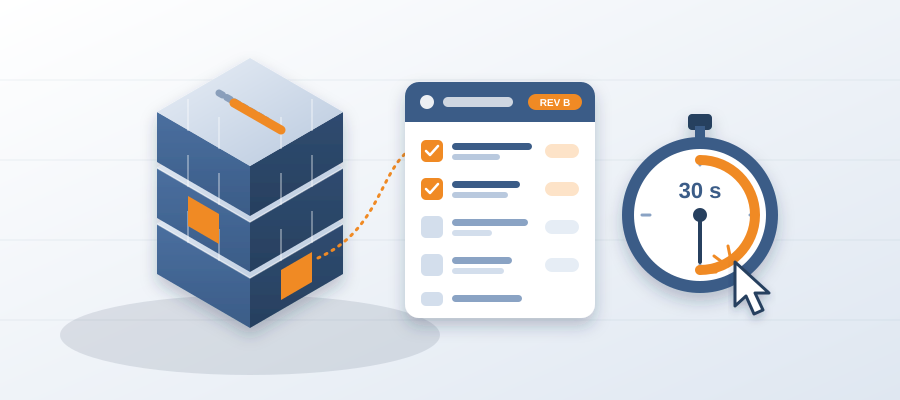
The Cost of a 30-Second Click
The Hidden Cost of a Quick Drag
You drag a wall six inches to the left. It takes half a second. The model looks fine, maybe even better. You move on to the next task. But that wall just changed what the ceiling crew, the framers and the electricians are going to build. Without a record that tracks every change, you will not see the effect until someone walks the floor. That could be days later.
In the meantime, you have made more changes. A door moved here, a window resized there. Each one is a 30-second click. Each one stacks on the last. By the time the field finds out, a section is built wrong. And you have no idea which click did it. That is the frustration we hear from every BIM coordinator and architect we talk to.

You know the feeling of discovering a conflict weeks after the design meeting. You have to trace back every change, work out who touched what and explain to the GC why the work is wrong. It is not just the time. It is the credibility hit. The team starts to question every drawing you send.
That is what we are here to fix.
BidLight lives inside Revit and Navisworks. When you publish after that click, the change shows up in the comparison within minutes, while the design is still fresh. No waiting for a meeting. No chasing scattered updates. Just a record that keeps pace with your design.
The cost of that 30-second click is only invisible if you do not look. With BidLight, you look. And you see exactly what changed, and who needs to know.
Why Your Record Drifts Without Version Control
Most coordination workflows are reactive. You send the model around, someone opens it, someone compares it by eye, and you get a reply days later. By then, the design has moved. So you repeat the process. That is why a single project might go through five or ten rounds of "which version is current?" Each one takes time and introduces errors. Teams lose about 11 hours a week to exactly that.

The real problem is that the record is always a step behind the model. It is like driving a car by looking in the rearview mirror. You know where you have been, but not where you are going. And the faster the design changes, the worse the lag gets.
BidLight fixes the lag. Each publish becomes a versioned snapshot with its own files, author and milestone. Any two revisions compare element by element, grouped by category: structural, MEP, envelope, interior. You are never guessing which file is current, because the record says.
That is what lets the click become visible. The wall that moved is listed. The door schedule that followed is listed. The ceiling that now collides is one issue away. Nothing has to be rebuilt from memory.

For the AEC industry, this matters. Coordination is a field where data changes fast and decisions depend on knowing what is current. Every click changes the data. Every change affects someone's work.
With BidLight, you do not wait for the next meeting. You see the change after every publish. That is how you keep the field aligned with the design, and that is how you defend your record with confidence.
Turning a 30-Second Click into an Owned Issue
Here is a phrase that comes up all the time: "What if we move the lobby?" In a traditional workflow, you would say, "I will have to get back to you." That means days of waiting, and often a surprise on site. With BidLight, you can answer in minutes. You publish, you compare and you see which elements the move touches. Then you tell the team who owns each one.
When you can provide that kind of answer quickly, you become more than a drafter. You become the person people ask first. Clients value that. And you are not just giving an opinion. You are giving the reasoning behind it, backed by the model.

This is not just about immediate wins. It is about building trust. When the team sees that every change gets flagged and owned, nobody has to second-guess the record. Nobody has to hire an outside reviewer to double-check you.
Closing is gated, too. An issue closes only with a screenshot, a tagged user and the model commit that fixed it. That is how a closed issue stays closed. And the 6am digest tells every owner what they hold, so you do not have to chase.
So think about that 30-second click. It is not just a design change. It is a chance to show the team you have the record under control. It is a way to turn a routine task into a calm, trackable one. And it is a way to set yourself apart from teams that find out on site.

The Real Cost of Finding Out a Week Later
Let's make this concrete. You are working on a commercial project. The schedule is tight. During a design review, someone suggests moving a structural wall 18 inches to maximize floor space. It sounds like a good idea. In a traditional workflow, you note the change and move on. The trades would catch it next week, maybe.
But what does that wall touch? New footings, rerouted MEP, different steel connections. The design still looks fine on screen. But the field just took a hit. If you do not find out until someone builds to the old drawing, you may have made additional changes that compound the problem. By the time you see the conflict, a crew is idle, and you have to scramble to explain why.
This scenario plays out every day. An unresolved clash can burn $15K to $50K a week in idle field labour. One that sat 47 days burned $28,000. The cost of waiting is not just the delay. It is the lost chance to adjust the design before it is built. A clash caught in the model costs about $50. The same one in the field costs $5,000 to $50,000.
That is why we built BidLight around the publish. When you make that click and publish, you see what it touches. You can evaluate the change right away. You can decide whether it is worth it. And if it is not, you can revert it. No wasted time, no hidden rework.

This is how you keep projects on schedule. Not by being perfect, but by catching problems at the moment they happen. That is the value of a record that runs as the work happens.