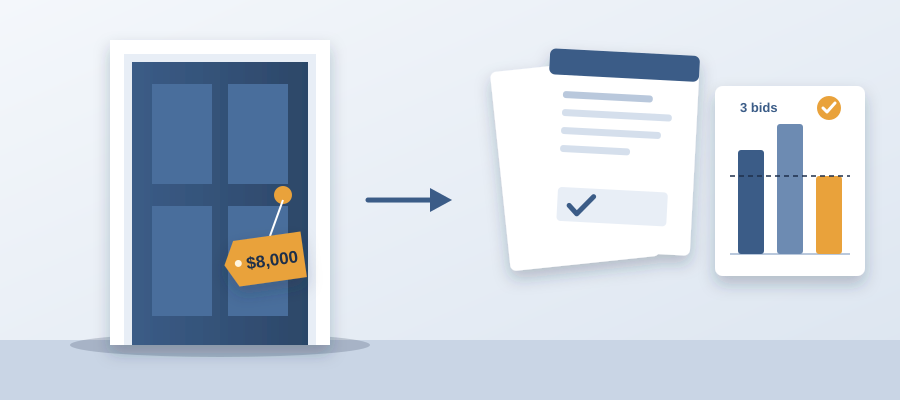
The $8,000 Door
The Hidden Cost Chain of a 6-Inch Door Move
When the design moves a door 6 inches, the estimate doesn't blink. But the steel frame, the header, and the schedule change. And that's before the wall moves. A typical commercial door assembly costs around $1,500 for materials and labor. But move it six inches and you might trigger a new steel lintel, a wider header, and a revised door schedule. That's easily $800 in added materials, plus another $700 in labor to rework the frame. In a project with 20 doors, that's $30,000 you didn't budget for.
Most estimators miss this because they work from static drawings or spreadsheets. They see the door in the same place on the plan, so they price it the same. But the model knows the door moved. It knows the wall intersection changed. It knows the header is now too short. The problem is the estimate doesn't talk to the model. So you find out at bid day, or worse, during construction.
Here's the thing: a door move isn't just about the door. It's about the wall assembly, the framing, the finishes, and the schedule. When you move a door, you change the wall's structural support. You might need a new header or a different stud layout. The door schedule in your Revit model updates automatically, but your cost estimate doesn't. That disconnect is where money leaks.

Bid management software that lives inside Revit closes that gap. Instead of exporting a schedule and re-entering quantities into an estimating tool, the software reads the model geometry and metadata directly. When the door moves, the model updates, and the estimate updates. No manual re-takeoff. No waiting for a new export. You see the cost impact the moment the change happens.
That's how bid management software works: it connects the design model to the cost database in real time. It doesn't guess. It reads the actual model and prices it against current market data. So a 6-inch door move doesn't slip through. The software catches the new header, the longer frame, the revised schedule, and gives you a defensible number before you even leave your desk.
Why Revit Material Takeoff Beats a Revit Quantity Schedule
A Revit quantity schedule lists every door, every window, every cubic yard of concrete. But a schedule is just a list. It doesn't tell you labor hours, equipment time, or material costs. A Revit material takeoff, on the other hand, extracts the actual quantities of materials from the model and links them to cost data. That's the difference between knowing you have 20 doors and knowing those 20 doors cost $38,000 installed.
BidLight's takeoff tool goes further. It reads the geometry and metadata to classify each line item at 86% accuracy. That means it knows a door is not just a door. It's a hollow metal frame with a wood veneer, a panic bar, and a fire rating. It pulls pricing from a database that costs roughly $30,000 a year to maintain, plus sources like RSMeans, 1Build, and Craftsman. So you're not guessing costs. You're using current, regional numbers.

The real power is that the takeoff updates in real time. When the door moves, the takeoff sees the change. It recalculates the steel frame, the header, and the schedule. You don't have to re-run a clash detection or manually adjust quantities. The software does it automatically. That's why bid management software pays off on projects with tight deadlines and frequent revisions.
Compare that to a traditional workflow. You export a Revit quantity schedule, import it into Excel, and spend hours mapping line items to cost codes. You might use a plugin or an API, but it's still a manual process. And if the model changes, you start over. That's why so many estimates are wrong the moment the design changes.
A Revit material takeoff is the bridge between design and cost. It gives you the quantities, the classifications, and the pricing all in one place. And when it's tied to a live model, it's always current. That's the difference between an estimate that's a snapshot and an estimate that's a living document.
How Much Does Estimating Software Cost? The BidLight pricing breakdown
You might be thinking: this sounds great, but how much does estimating software cost? BidLight is priced per licence, billed annually or monthly. Basics is $260 per licence per year or $30 a month, Core is $330 or $39 a month, Complete is $440 or $51 a month, and Max is $590 or $69 a month. Enterprise pricing is custom. Every plan includes unlimited projects and in-BIM estimation; standalone estimation starts at Core, and pricing and custom databases plus 2D takeoff come with Complete.

If you're an AIA member, you get a discount of up to 29%. Even without it, a Basics licence is $260 a year. Compare that to the cost of one missed change order on a typical job, which can easily be $10,000 or more. The software pays for itself the first time it catches a revision you would have missed.
BidLight also offers done-for-you BIM services. If you don't have the capacity to do your own execution plans or 4D/5D modeling, BidLight can do it for you. Those services are priced separately, so you only pay for them when a project needs them. And you can bill those early estimates to clients, turning a cost center into a revenue stream.
When you're evaluating estimating software, don't just look at the monthly price. Look at the time you save. A manual takeoff for a mid-size commercial building can take 20 to 40 hours. With BidLight, it's minutes. If your billable rate is $100 an hour, that's $2,000 to $4,000 per bid saved. Even at the Max licence price of $590 a year, you're ahead after one bid.
So the answer to how much does estimating software cost is: it depends on the size of your projects and the value you place on accuracy and speed. BidLight's pricing is transparent, and the ROI is clear. When you see the cost of a missed door move, the software starts looking pretty cheap.

From Change to Cost: How Real-Time Estimation Wins Bids
The real value of bid management software is not the initial estimate. It's what happens when the design changes. In the traditional workflow, a change means you re-run the takeoff, re-export the schedule, re-price the materials, and re-send the estimate. That takes days. Meanwhile, the client is waiting, and your competition is sending in a new number.
With BidLight, the estimate updates in real time. The door moves, the steel frame changes, the header updates, and the cost recalculates. You see the impact instantly. That means you can answer your client's 'what if' questions on the spot. Instead of saying 'I'll have a revised estimate next week,' you say 'That change adds about $4,200, and here's the breakdown.'
That speed is a huge competitive advantage. It lets you lock in the design early, before costs spiral. It also lets you bill for early estimates, because you can produce them without burning hours. You can offer cost advice during schematic design, when changes are cheap, instead of waiting until construction documents, when every tweak costs money.
Say you use BidLight to respond to client change requests within the hour. You send a detailed cost impact report with material, labor, and equipment costs. The client is impressed. You win more work because you're more responsive. And you can charge for those reports, adding a new revenue line.

That's the power of real-time estimation. It doesn't just keep your numbers straight. It changes your relationship with clients. You become the advisor who can say 'here's what that costs' without breaking stride. And that's what wins bids, not the lowest price, but the most reliable number delivered fastest.
Start Turning Revisions into Revenue
If you're tired of chasing scattered updates and slow takeoffs, there's a better way. BidLight lives inside Revit, so you don't have to leave your model. You get accurate, defensible numbers in real time. And when the design changes, you see the cost impact right away.
Don't just take our word for it. Request a demo, and we'll walk you through it on your own model. Move a door. Watch the estimate update. See the new frame, the new header, the new price. You'll see why bid management software is the future of estimating.
And when you're ready, you can also use our done-for-you BIM services. We handle execution plans, 4D/5D, and fabrication detailing, so you can focus on design. Or you can use the tool to turn early estimates into a service you bill for.

The bottom line: a 6-inch door move might not seem like a big deal. But in construction, small changes add up. With BidLight, you see every change order coming. Your estimates will be accurate, your clients will trust you, and you'll win more work. Stop chasing updates. Start winning bids.
Visit bidlight.com to see how BidLight can transform your estimating process. Your next revision is already waiting. Price it before your competitor does.