The 6am Digest Email Nobody Wants to Send, and Why That Is the Point
Somebody on Your Team Is the Human Version of a Status Report
Ask around any mid-size AEC firm and you will find the same job hiding inside someone else's title. BIM lead. Project engineer. Coordination manager. Every morning they stop doing their actual job and become a status report. They open Revit. They open Navisworks. They open the shared drive, the RFI log, and four email threads. Then they write it all down so everyone else can start the day pointed the same direction.
That person is not writing anything the model does not already know. Every element, every revision, every open issue exists somewhere. It is just spread across files and inboxes that do not talk to each other, so a person crawls through them by hand and retypes the answer at dawn.

Here is what that costs. An hour or two a day for one senior person, spent on retyping things that were already true in the model when they were written. That is time the coordinator does not spend finding the clash that is about to reach the field.
And the hours are not the worst part. The worst part is that the digest is stale the moment it lands. The architect pushed a wall at 7:40. Somebody moved a grid at 8:15. By the time everyone has read the 6am email, it describes a project that no longer exists.
The people reading it know. They still ask in the 10am call: did anything change? That question is the real cost. It means nobody trusts the digest, so the chase starts over anyway, and the person who wrote it gets asked to do it again tomorrow.
The Digest Is Not the Problem. The Manual Compile Is.
Be clear about what is wrong here. The 6am digest itself is a good idea. One morning readout that tells every owner what they own is exactly what a project needs. The problem is a human assembling it by hand every day, because hand assembly is where the errors live.

Manual compiles fail in familiar ways. Someone forgets to check the RFI log. Someone reports on Tuesday's export because that was the last one they opened. Someone marks a clash as resolved when it was closed in a chat thread but never changed in the model. None of that is carelessness. It is what happens when one person tracks several moving records with their eyes and their memory.
On the job, those errors have a cost. A clash marked resolved that is not resolved shows up in the field. A fixed clash costs about $50 in the model. The same one found on site costs $5,000 to $50,000, and an unresolved one can burn $15K to $50K a week in idle field labour. A status line that says "closed" when it is not is how you end up paying the second number.
Now think about the daily rhythm. If your digest is built by hand, updates arrive once a day, in one direction, already behind. If it is built from the live record, everyone reads the same version of the project at the same time, and the owner of each issue is named.
The point of the 6am digest is not the email. It is the shared truth it delivers. If the email is the only thing carrying that truth and a tired person writes it at 6am, you have a single point of failure with a nice subject line.

How to Measure the Chase Over Time Without Fooling Yourself
Most firms measure nothing here, which is why the pattern repeats. Someone says the morning update takes about an hour. Nobody checks. A year later it takes ninety minutes and two people, and still nobody has a number.
If you want to know whether this is a real problem or just an irritation, measure it like any other cycle. Count the hours between a model change and the first person outside the authoring team knowing about it. Count how many times a week someone re-asks a question the digest already answered. Count how many rework hours trace back to a version that was current when it was read and wrong by the time someone acted on it.
Then watch two simple trends over a few weeks. How many issues are open per owner, and how long do they sit before they close? BidLight tracks both per person through the Problem Solver Index, so you read them off the record instead of building a spreadsheet. A median of 7 days to close is a useful reference point. If yours is far above it, you know where the schedule is leaking.

The Digest That Writes Itself and Still Says Something
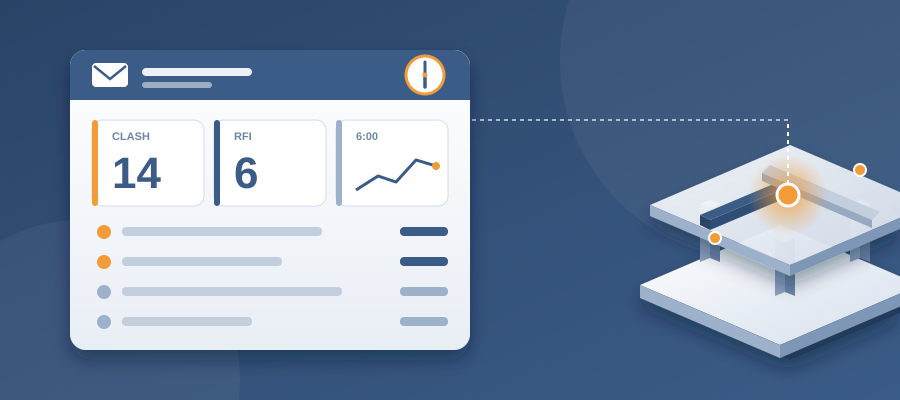
BidLight keeps one live record of the project inside Revit and Navisworks. You publish from the model and each publish becomes a versioned snapshot with its own files, author and milestone. Any two revisions compare element by element, grouped by category: structural, MEP, envelope, interior. That means the 6am digest is no longer a report about the project. It is a readout of the project.
Every issue in it is pinned to the element it concerns and carries the sheet and revision that raised it. Each one has an owner. Closing one takes a screenshot, a tagged user and the model commit that fixed it, so "resolved" in the digest means resolved in the model. When an architect moves a wall on Tuesday afternoon, Wednesday's readout shows what moved and who has to act on it.
The team that gets the 6am digest is the team that stops asking whether anything changed. The change is already in the record. The clash is pinned to the geometry. Nobody has to compile it because nobody assembled it in the first place. It was always just the state of the project, formatted and sent.
That changes what the morning meeting is for. Instead of lining up reports, you decide what to do about what the report says. Working out what changed takes about 15 minutes instead of a 90-minute meeting. That is the shift, and it is not really about email. It is about where the truth lives.

What This Looks Like When You Stop Chasing Updates
Picture the same firm six months later. The BIM lead is not writing the morning update. She reads it before she gets to the office. Each line has a name next to it, and the ones that are behind are obvious while there is still schedule left to move work.
When the project manager calls at 2pm and asks what a layout change touches, she answers on the call. She opens the compare view, selects the two revisions, and reads which categories moved and which owners are affected. The same record that makes the digest possible makes that answer possible. Her status update is just the project with a timestamp.
That is how you stop walking into the GC meeting three weeks after a slip started. You see who is behind on day two, not day twenty-one. The cost control comes from there: fewer surprises that turn into rework, idle crews and change orders.
The 6am digest is a small thing. One email, once a day. But it is the clearest signal of whether your firm is still chasing updates or has moved past the chase. If someone on your team spends the morning being the human version of a status report, that is not a process to manage. It is a job to delete, and the record should do it instead.

Start there. Pick one project. Stop compiling the digest by hand for thirty days and let the record speak for itself. If nobody misses the manual version, you have your answer about how the rest of your reporting should work.