The $30,000 Question Your Competitor Won't Ask
The Real Cost of Guessing on Unit Prices
Every estimator has been there. You finish a takeoff, pull unit prices from a mix of past projects, supplier quotes, and maybe a quick Google search. You adjust for location, add a margin for error, and submit. Then your competitor comes in two thousand dollars lower. Not because they cut corners or worked faster on takeoff. Because their pricing database is current, comprehensive, and tailored to your region. That two-thousand-dollar gap represents the margin you could have protected.
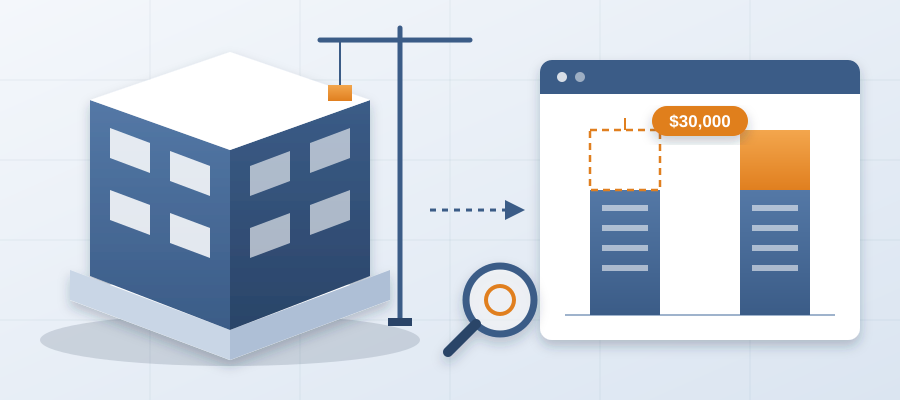
What Goes Into a $30,000 Database
A comprehensive pricing database is expensive to keep current. BidLight's own database costs roughly $30,000 a year to maintain, and it sits alongside Craftsman, 1Build, and RSMeans. That spend covers labor rates, material prices, and equipment costs that reflect real market conditions. Without that, you are relying on stale numbers from a job two years ago or a national average that does not account for your city’s prevailing wage. The gap between a current database and an educated guess can easily be enough to lose a bid.

How AI Estimation Closes the Data Gap
This is where the question of how AI estimates construction costs gets a practical answer. BidLight gives you that pricing data without requiring you to buy and maintain separate subscriptions. When you export a Revit model, two AI models read the geometry and metadata to classify each line item. They match your building elements to the correct cost codes, pulling current pricing from the database. The process takes minutes, not hours. More importantly, the system updates automatically when the model changes. If an architect moves a wall, the cost estimate adjusts in real time.
From Traditional Takeoff to 5D BIM Cost Estimation Workflow
A 5D BIM cost estimation workflow transforms how you deliver early-stage budgets. Instead of waiting for a fully detailed design, you can generate conceptual estimates from a Revit model at any level of development. For projects using an LOD 400 Revit model, the AI has richer geometry and metadata to work with. Two machine learning models classify bill of quantities (BOQ) line items at 86% accuracy. That leaves a small but manageable gap for estimator review, which is still faster than manual takeoff from scratch.

AEC Machine Learning Cost Prediction Versus Traditional Manual Methods
Comparing AEC machine learning cost prediction with traditional cost estimating reveals where time and accuracy trade off. A traditional estimator might spend a full day on a mid-size commercial project: measuring quantities, looking up unit prices, and building the estimate in a spreadsheet. The AI platform does the measurement and price lookups in minutes. The trade-off is that the AI cannot yet handle highly custom assemblies or proprietary systems without human override. For standard construction categories—concrete, steel, drywall, MEP rough-in—the models handle the routine classification and you review the exceptions.
The Practical Cost of Sticking with BIM vs Traditional Cost Estimating
The debate over BIM vs traditional cost estimating often focuses on software adoption curves. In practice, the bigger factor is database access. Traditional estimating can be fast and accurate if you have current unit prices and regional modifiers. The problem is that maintaining a personal cost library requires constant updating. BidLight effectively outsources that maintenance. By embedding the cost databases directly into the Revit workflow, it eliminates the step of exporting quantities and cross-referencing external spreadsheets. The result is not just faster estimates but estimates that can be defended in a value engineering meeting or an owner review, because the data source is transparent and auditable.

Reducing Cost Estimating Errors in AEC Projects with AI Verification
One of the strongest arguments for adopting AI estimation is the ability to reduce cost estimating errors in AEC projects. Human estimators make predictable mistakes: fat-finger quantity entries, forget to apply a location factor, or double-count an element that spans two model views. The AI catches those patterns. Every publish is also a versioned snapshot, so when the model changes you can compare revisions element by element and see what moved. This turns the estimator’s role from data entry to review and judgment—a shift that improves both speed and confidence.
Turning Early Estimates Into a Billable Service
For firms that want to offer pre-construction cost advice, the AI platform makes early estimates a service you can charge for. When a developer asks for a preliminary budget during schematic design, you can run the model through BidLight and deliver a line-item cost estimate in the same meeting. The speed lets you take on more early-phase work without expanding your estimating team. The confidence comes from knowing the prices are anchored to the same databases your competitors use—at least, the smart ones. The ones who keep guessing will keep wondering why their bids come in two thousand dollars too high.
