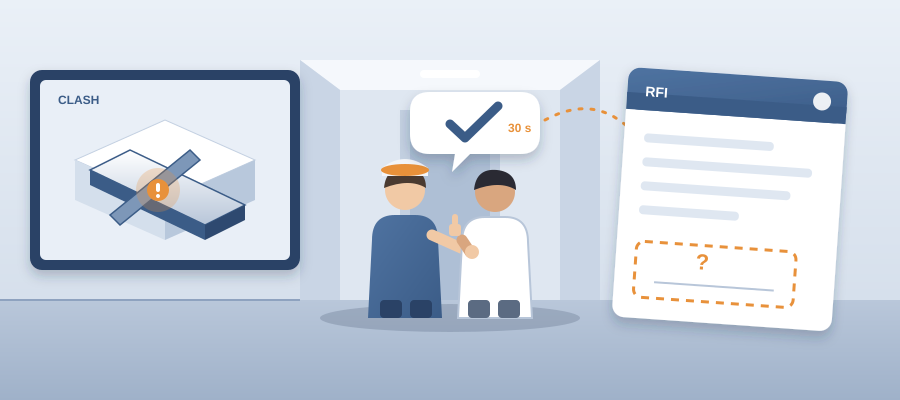
The 30-Second Hallway Yes That Never Gets Recorded
The 30 Seconds That Sets the Plan
You are in a hallway with a coffee in one hand. A superintendent asks whether the mechanical team can drop a duct run to clear a beam. You think about the ceiling, remember a similar job from four years ago, and say sure. Thirty seconds. The conversation moves on and everyone feels good.
That yes does not stay in the hallway. It walks into the next coordination meeting. It gets written into a memo. Somebody mentions it to the foreman, who tells his crew, who start building. You never recorded the decision, but the project now has a plan.
The hallway is not the problem. The problem is that nothing afterward checks the yes against the model. The design changes. The ceiling trade does not hear about the new duct. The change sits there aging like fruit. By the time the conflict reaches the field, you are defending a decision you made in thirty seconds with a coffee in your hand.


Here is the part that stings. The decision was never wrong in a way anyone could catch. It just never got recorded. No diff. No flag. No issue turning red. Everyone assumed the change had reached the people who needed it. Nobody asked how.
The habit is small. The cost it creates is not. A clash caught in the model costs about $50. The same clash found in the field costs $5,000 to $50,000.
Why a Quick Yes Feels Safe and Isn't
A quick yes feels safe because it is fast and it ends the conversation. Nobody gets angry at a fast answer. Nobody pushes back on an approval. And in the moment, the person asking usually wants a direction, not a document.
Then the yes gets a job it was never meant for. It becomes a plan. Then a commitment. Then the thing a trade remembers you said. A call that was fine in a hallway is now a sequence in the field, and you made it with a shrug.
Quick decisions also do not stay isolated. They stack. One unrecorded duct move feeds an unrecorded ceiling change, which feeds an unrecorded sprinkler shift. Those do not average out into one good plan. They compound into a clash nobody owns, and an unresolved one can burn $15K to $50K a week in idle field labor.


That is why coordination tools exist. Teams adopt them to stop the compounding. One source where every change traces back to an element and an owner, not to memory.
Coordination has always treated speed and rigor as a trade. Be fast or be right. The hallway habit sits on that trade, and the trade has to go.
What the Record Looks Like When It Updates Itself
BidLight keeps one live record of the project inside Revit and Navisworks. The record rides on the same model the designer is editing. You publish from the model and every publish becomes a versioned snapshot with its own files, author and milestone.
When the design changes, the next publish shows it. No waiting for the next meeting. No manual walk-through. Any two revisions compare element by element, grouped by structural, MEP, envelope and interior.
Issues pin to the element they concern. The hallway yes becomes a record in about a minute: you pin an issue to the duct, tag the ceiling trade and the sprinkler foreman, and the issue carries the sheet and the revision it came from. It is not perfect, and we will not pretend it is. It is a record you can audit and correct in seconds.


Closing is gated. An issue closes only with a screenshot, a tagged user and the model commit that fixed it. So when someone asks where a decision came from, you can answer.
The result is a single record. Model, issue, owner and revision, all tied to the same object in the same file. When the ceiling grid moves six inches, you know who has to act before you leave the room.
The Hidden Cost of Good Enough
A recorded change changes the job, but it changes something else first. It changes your week. A comparison in about 15 minutes instead of a 90-minute meeting. Across a firm, that is where the hours come from. On the hyperscale programme, BidLight helped save 18,000+ hours and $12.3M in cost.
Those hours go back into work that keeps the schedule. Solving the clash instead of finding it. Sitting with the trades while they decide, instead of promising an answer by Thursday. Teams that record the change in the room do not wait to hear about it from the field.
There is a second cost most firms never put on a line. Every repeated reconciliation wears on your own team. Coordinators leave when the job is copy-paste and chasing. They stay when the job is judgment. Let the software hold the history. Let the coordinator decide.

The third cost never shows up because it never closed. The change you did not chase because nobody tagged an owner. The trade that went idle because nobody told them the duct moved. The clash you solved twice and lost on the second pass. None of it appears in a status report.

Good enough looks like it saves thirty seconds. It costs you schedule, margin and the trust of the person who asked for an answer first.
How to Tell a Real Record From a Chat Thread
Try this test. Pick one decision from last week and ask where it is recorded. If the answer is a message that links to another message that links to a call someone remembers from April, that is a chat thread, not a record.
A real record traces every decision back to an element and a date. This duct, this level, from this model revision, assigned to this person, closed on this day with this proof. If any link is missing, the decision is a guess with formatting.
When you evaluate any coordination tool, run the same test on it. What happens when the model changes? What happens when someone says yes in a hallway? Does each issue carry an owner, a sheet and a revision? What does closing actually require?

We make closing hard on purpose. The gate is the point. The tool does the recording. The human does the deciding.

The same discipline applies outside construction. A tool that sorts and records is helpful, auditable and never the final word. The tool logs. The person confirms. You get a first pass you can check, not a black box you have to trust.
If you are weighing a shared folder and a spreadsheet, try them. Compare on the trace, not the demo. Ask each one the same two questions. Where did this decision come from? When did it last change?
Stop Defending the Yes. Record It on the Model.
The habit will not end because someone tells you to be more careful. It ends when the fast answer and the recorded answer are the same answer. You cannot out-discipline a thirty-second shortcut while you are standing in a hallway.
BidLight puts the decision in the room and in the model as the same record. One live record inside Revit and Navisworks. Issues pinned to the geometry. Changes you can defend in minutes.

Plans are per licence, with unlimited projects on every plan. Basics is $260 a year. If you want the done-for-you version, we do that too: execution plans, 4D sequencing, fabrication detailing and spooling. Software or service, the record is one.

Will BidLight fit your firm? It depends on what you do most. Heavy design-change volume and many trades working in the same space, you will feel it in week one. Steady single-family work with few changes, try Basics on one project first.
The pitch is plain. No more chasing scattered updates across email and Teams. Close issues with proof. Know who is behind while there is still time. If you remember only one thing, remember this. BidLight keeps one live record of the project inside Revit and Navisworks, so a yes in the hallway becomes a decision on the model. Everything else follows from that.