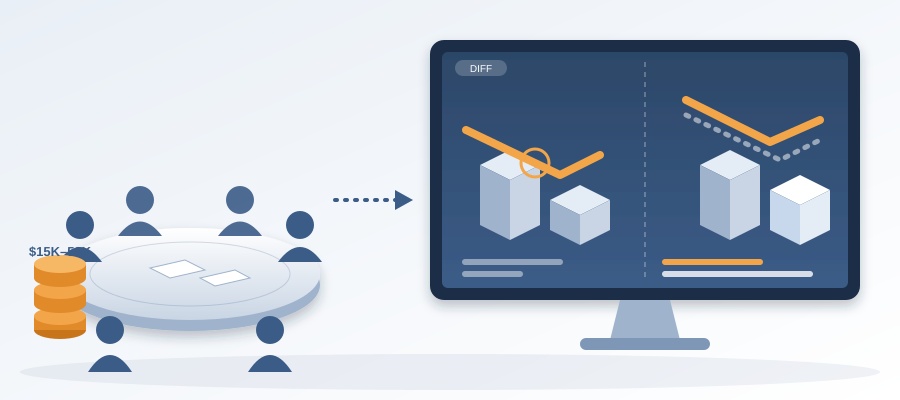
The $15K to $50K a Week You Are Paying for a Meeting That Should Have Been a Diff
The Meeting Is Not the Cost. The Waiting Is.
Your coordination meeting has a price tag. It reads $15K to $50K a week in idle field labor behind an unresolved clash. That is not the meeting room. That is the crews on site who showed up ready and got told to hold until the clash list gets sorted.
Picture the Monday morning coordination call. Ninety minutes walking through a batch of conflicts that nobody has touched since the last export. Much of that time goes on hunting one duct. Somebody moved the riser, somebody else moved the beam, and the version in the room is neither of them. You pay for that in standing labor, not in meeting minutes.
The brutal part is that the answer existed. Something in the model had already changed. Nobody had a clean record of what changed, when, and what it did to the other trades. So the room argued about geometry instead of deciding who does what.

Look at what a stuck clash does to a job. A clash that sat 47 days burned $28,000 in idle field labor. Stack a couple of active areas and a deadline at the same time and a single week can climb well into the range above without anyone deciding it should.
The fix is not a shorter meeting. The fix is arriving with a diff: here is what moved in the model since last week, here is what it touched, here is who owns it. That is a 15-minute conversation. The 90-minute one is what you get when nobody has it.
What Two Hours Hunting a Duct Looks Like
Picture the scene every MEP contractor knows. The mechanical foreman flags a duct that will not fit above a corridor ceiling. The structural model says the beam is deeper than the last coordination set showed. The architect moved a soffit two weeks ago to make room for a light cove. Three people in the room have three different versions open, and the version on the projector is four days old.
So the meeting turns into archaeology. Someone goes back through email to find the last set. Someone else calls the detailer to see if the change ever made it into the working model. The plumber waits to know if he can hang. The electrician waits to know if the rack moves. The drywall crew is on site and cannot start until the ceiling grid is set. Two hours later you have a decision, and a full day of field labor has gone by.
That is the specific, repeating moment this is about. Not a big dramatic failure. Just a duct nobody could get a straight answer on, eating a morning and a payroll.
If you sell BIM coordination, the whole value you offer is being the team that knows what is current. If your own coordination meetings cannot establish that in the first ten minutes, your client is paying you to be confused on their behalf.

There is a version of that morning where the diff is waiting before the meeting starts. Duct at grid C4, dropped 6 inches. Beam depth changed last Tuesday. Soffit added by the architect on Thursday. Each change pinned to its element, with the sheet and the revision that raised it. The meeting becomes an assignment sheet instead of a deposition.
A Standing Meeting Is a Slow Release Valve
Most firms coordinate on a weekly rhythm because that is what they have always done. Friday export, Monday meeting, Wednesday answers, repeat. In a design that is moving every day, that cycle is a five-day lag on every single change. Multiply that by every trade every week and you have a steady bleed.
Weekly meetings are not evil. Weekly meetings where the content is five days stale are the problem. If the team saw a diff every morning, the Monday meeting would still exist. It would just be where you settle the hard clashes, not where you reconstruct what happened last Tuesday.
The cost of that lag is not abstract. It is time on the clock in the field. A crew that showed up and cannot proceed is a crew being paid to wait.
The Number That Makes This Real
Here is how to think about the cost of a stale coordination meeting. Write down, for one week, every hour a crew stood idle waiting on an answer that lived inside the model. Include the half hours. Include the times a foreman had to walk back to the trailer to check something. Include the rework when a duct got installed at the wrong elevation because a superseded drawing was in the truck.
On many jobs that lands between $15K and $50K a week once an unresolved clash is holding up a crew. The low end is a coordinated team with a light schedule. The high end is a job in active construction where three trades are chasing each other through the same corridor.

And it compounds. Idle time misses a milestone, the milestone slips a week, the week pushes back the drywall, the drywall push changes the ceiling grid, and the ceiling grid changes the light layout. Every one of those downstream moves is a new coordination problem, which creates another slow meeting, which creates more idle time.
What makes this hard to see is that none of it appears as a line item called idle labor. It appears as a labor line that looks a little high. It appears as a schedule that keeps sliding two weeks at a time for reasons nobody can quite name. It appears as a general contractor who likes your work but thinks you are slow.
That is the cost of not having a diff. Not one big hit. A persistent drip that hides inside the schedule and slowly eats the margin.
Compare it with the other end. A clash caught in the model costs about $50. The same clash found in the field costs $5,000 to $50,000. Same conflict. The only difference is when someone saw it.
Why a Diff Beats Holding the Meeting First
The old workflow was: meet, discuss, decide, update, export, meet again. The better workflow flips it. Publish, compare, assign, then meet for 15 minutes to confirm ownership. You are not replacing human judgment. You are giving people something to judge.
In BidLight, every publish from Revit or Navisworks becomes a versioned snapshot with its own files, author and milestone. Any two revisions compare element by element, grouped by category: structural, MEP, envelope, interior. So when the architect moves a soffit, the diff lists the elements that moved, and the coordinator reads it before anyone walks into the room.

Issues do the rest of the work. An issue attaches to the Revit element it concerns and carries the sheet and the revision that raised it. It does not close on a nod in a meeting. It closes with a screenshot, a tagged user and the model commit that fixed it. The median issue closes in 7 days. A closed issue means something, so the same problem does not come back on site.
That is what makes the 15-minute meeting possible. The coordinator already knows the duct moved, the project view already shows who owns the fix, and the room just decides what happens next. The team that used to spend two hours hunting the duct spends ten minutes assigning the repair.
And the record keeps updating, so the next meeting starts from current data instead of last Friday's snapshot. The meeting stops being a recap and becomes a decision.
The 6am Digest Takes the Chasing Out
There is a second saving that is bigger than the meeting itself. Nobody has to chase. Every morning at 6am, each owner gets a digest of the issues assigned to them. The foreman sees the duct at C4 before he leaves the truck. The detailer sees the beam change before the first call of the day.
Most schedule slips start quietly. A task sits with one person for three weeks and nobody notices until the GC meeting. The digest and the project view show every issue against its owner, per person, while there is still schedule left to move work. The Problem Solver Index makes resolution rates visible, so accountability does not depend on someone walking the floor.
When you can see who is behind on Tuesday, you reassign on Tuesday. When you only find out at Friday's meeting, the crew has already waited. That is the whole difference, and it is measured in days of idle labor rather than in minutes of meeting time.

What This Does to the Whole Schedule
A model that tells you what changed is not just a coordination tool. It changes how the job feels. Fewer surprises on site. Fewer rework conversations. Fewer RFIs that exist only because nobody could find the current answer. Fewer change orders that start as an unflagged model change and end as a dispute.
That is the 11 hours a week many teams lose working out which model version is current, handed back. The hyperscale programme is the example we can point to: 18,000+ hours saved, 8,900+ issues resolved and $12.3M cost saved. Those are field problems that never happened because someone saw them in the model.
You do not have to take that on faith. Pick one active area, run it for a month, and count the hours a crew stood idle waiting on an answer. Then count them again with a morning diff and the digest in place. The comparison is specific to your project, your trades and your people, and it will tell you more than a demo.
How to Turn the Meeting Into a Diff
The practical version is not complicated. Publish from the model on a schedule. Every morning, not every Friday. Each publish is a snapshot, and the comparison to the last one tells the team what moved.
Then the agenda becomes the diff. What moved. What it touched. Who owns it. The foreman opens the list, sees the duct at C4 changed, and tells the room when he can install. The coordinator opens the same list and confirms the owners. There is no catching up because there was no gap to catch up across.
Plans run from $260 per licence per year at Basics to $590 at Max, with Enterprise pricing for larger setups, and every plan includes unlimited projects. If you are paying anywhere near $15K a week in idle labor, that math is not close. One avoided stall on one job pays for a full team of licences several times over.

You can also hand the work to us. BidLight does done-for-you BIM work: execution plans, 4D sequencing, fabrication detailing and spooling. If you would rather have people who do it all day set up the coordination, that is the same record, run for you.
The point is not to abolish the coordination meeting. The point is to stop paying $15K to $50K a week for one that should have been a diff. Run the diff, hold the meeting, and watch what it does to your schedule, your rework and your idle crews.