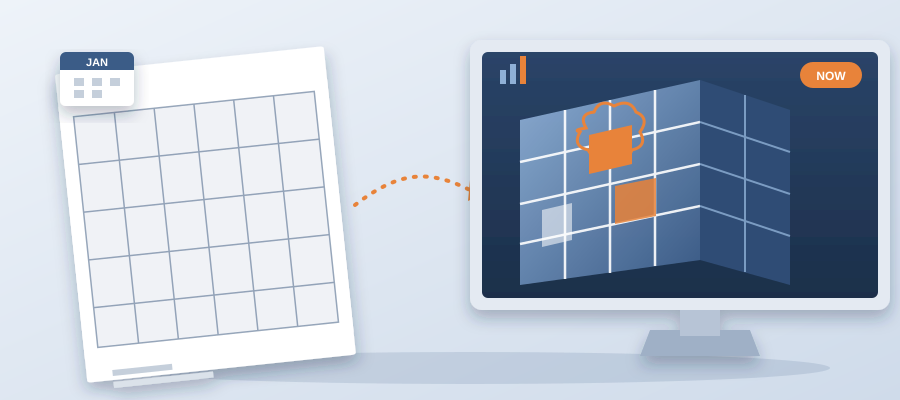
Issued the Curtain Wall in January? The Model Has Moved Since.
Why a January Coordination Issue Isn't Worth the Paper It's On
You issued that curtain wall coordination in January. It felt solid then. But the model has not stayed still. By the time the facade trade is fabricating, the mullion depth has changed twice, the glass type has been upgraded, and a slab edge has moved. That is not a rounding error. On a 10,000-square-foot facade, one stale revision can mean panels cut to the wrong size. Most teams do not catch that, because they are working from an outdated set.
Your team probably has a shared folder of exports and a spreadsheet of who holds what. You update it when you remember. Maybe weekly, maybe when a trade emails to ask. But the model moves daily. Slab edges, structural revisions, ceiling heights, the architect's last-minute fix. Each one nudges the geometry. By the time the trade is ready to fabricate, your baseline is already stale.
You end up finding out at fit-up, when a panel does not meet the slab edge. Panels remade, crews standing by, a change order to argue over. None of that is a good look. And you cannot just blame the model. The schedule holds you to that date once you commit.

So you scramble. You call trades, chase confirmations, open three versions side by side. That takes days, and the fabrication window does not extend. You either move fast or you miss the slot. Most teams accept this as the cost of doing business. But it does not have to be.
BidLight keeps every export as a versioned snapshot with its own files, author and milestone. When you publish your Revit model, the comparison against January is a click away. If the mullion depth changed, the diff shows it, grouped under envelope. That is the difference between guessing and knowing.
The Real Cost of Chasing Scattered Updates
Think about the last time a curtain wall changed. The architect revised the mullion depth. Or the glass type was upgraded. You had to tell the facade trade, the structural engineer and the ceiling contractor, one by one. Then you had to check they had updated their models. Maybe the markup is in one email, the new section is in a chat and the revised sheet is on a drive. Each change means revisiting all of them.
That is hours of work, if not days. Time you could spend closing real clashes. And the risk of error is huge. Miss one party and a trade builds to the old version. You do not know until the panels do not fit. Or worse, until the facade is half up and the crew is waiting.
This is the headache every coordinator knows. You chase scattered updates across emails, PDFs and old markups. Someone might have the latest section, but they are out sick. Or it is buried in an old thread. So you make do with what you have. That is not a strategy. That is a gamble.

BidLight lives inside Revit and Navisworks. You publish your model and the changes land in the comparison in minutes. When the design changes again, you publish again. No more chasing. No more version confusion. The record is always current, always consistent.
It is not magic. It is a versioned record plus a comparison by category: structural, MEP, envelope, interior. The system knows what changed and shows it, one element at a time. You get a record backed by the model, not by memory.
How an Element Diff Keeps Trades on the Right Version
Imagine you are coordinating a mid-rise office building. The facade is a significant part of the risk. You know the model is moving, but you are not sure by how much. A week before fabrication, the architect sends a revision that changes the curtain wall system. With a traditional approach, you would rebuild your understanding by hand, which takes days. With BidLight, you publish and get the diff in minutes. It shows exactly what moved, so you are confident the right people hear about it.
That confidence shows in your coordination. You are not guessing which trade has which version. You are not hoping the call went through. You pin an issue to the changed elements, tag the facade trade, and the 6am digest makes sure they see it. That is how you keep the job on schedule at the right quality.
When the client wants a change, you can respond on the spot. The model updates, the diff updates, and you tell the team what it touches before they finish asking. That is not just efficient. It is a service you can sell. Clients stop seeing you as slow or reactive. They see you as responsive and informed.

It is also about trust. When you tell a trade the geometry changed, they expect it to be true. If a panel is wrong, you can show them the revision and the commit. The model changed, and here is the proof. That transparency builds long-term relationships. It reduces conflict and change-order disputes.
A clash caught in the model costs about $50. The same clash found in the field costs $5,000 to $50,000. You stop paying for jobs you rebuilt by accident. You stop chasing explanations you cannot give. A versioned record is not a luxury. It is how you keep the field honest.
Turning Version Control into Time Back
Most coordination teams burn their week on version questions. Which file is current? Did the trade get the update? Did the sheet change? That is the thing nobody budgets for, and it is where the hours go. Teams lose about 11 hours a week working out which model version is current.
Think about it. A trade is deciding between two facade details. They want to know which one fits the structure. You can publish both options and compare them to the current model in the same meeting. That is value they cannot get elsewhere. It positions you as the person who helps them make informed decisions.
This gives you back your coordination time. You are not just waiting for the next crisis. You are running a calm process from day one. And because the record is based on the model, it is accurate enough to stand on. Trades trust it. They will come back when the project moves forward.
It also changes how you work internally. Instead of spending a day on version checks, you spend about 15 minutes. That frees you to focus on more complex tasks, like sequencing or clash reviews. You are not buried in folders. You are adding real value.

On the hyperscale programme, the case study shows 18,000+ hours saved and 8,900+ issues resolved. That is what a team gets when versions are visible and every issue is owned. The software pays for itself many times over, even on a Basics licence at $260 a year.
The Hidden Trap of a Static Record
Let's go back to that curtain wall. You issued it in January. By April, the model has moved. If you did not update the trade, they might fabricate to the old version. If that happens, you are starting installation already in the red. You will spend weeks trying to recover through change orders or rework that might not be acceptable.
Or the trade catches it late and stops work. A crew sits idle. An unresolved clash can burn $15K to $50K a week in idle field labour. One that sat 47 days burned $28,000. Either way, you are out of the running for the original plan. And the client might remember that. They might not call you next time.
That is how you lose trust, not just time. It is a slow leak in your reputation. But it is preventable. If your record updates with every publish, nobody works from outdated information. You never have to scramble at the last minute. You have a history you can defend.
This is why a versioned record matters. It is not just a convenience. It is a risk management tool. It protects your schedule and your client relationships. It helps you sleep at night, knowing your trades are building from facts, not wishes.

BidLight keeps the history in one place, so you are always working with the current model. And if the design changes, you see the effect immediately. No more surprises at fit-up. No more "we would have caught it if we had known."
Practical Steps to Start Tracking Today's Model
You do not need to overhaul your entire workflow overnight. You can start using BidLight on your next revision. Publish your Revit model, compare it with the last milestone and review the list. See the difference.
The learning curve is minimal. If you know Revit, you know BidLight. It lives inside Revit and Navisworks, so there is no separate portal to manage. That means no retraining your team and no disruption to your process. You just get better data faster.
Start with a single project. Publish the model, compare it to the January issue, and pin issues to the elements that moved. Show the facade trade the list. See how they react. They will likely be glad to hear it from you, not from a foreman. That is the first step to making the record the place everyone looks.
As you get comfortable, you can expand. Use it for more projects. Let the comparison handle the repetitive work. You can focus on the nuances it cannot see, like unusual site conditions or special sequencing. Together, you get the best of both worlds.

BidLight is priced per licence, billed annually or monthly. A Basics licence is $260 a year ($30/month), Core is $330, Complete is $440, and Max is $590. Enterprise pricing is custom, every plan includes unlimited projects, and AIA members get discounts of up to 29%. One avoided rework event can cover the annual cost.
The takeaway is simple. The model moves. Your record should too. With BidLight, it does. You stop chasing scattered updates. You hand the trades the right version. You close issues with proof, and the field stays on schedule.