The Walkthrough Meeting Where a Real-Time Estimate Closes the Conversation Before It Starts
The Meeting Where the Number Actually Matters
Most firms leave that meeting with an action item and a three-day turnaround. The client asked a question in a room full of people, you said you'd get back to them, and the energy in the conversation dropped the moment the answer got deferred.
Here is the shape of it. The architect walks the client through the redesign. A wall moves. A corridor gets wider. Somebody asks what that does to the budget. Everyone in the room looks at the person holding the model. That person says the estimate will take a few days, and a small trust cost gets paid right there. The number the client wanted was a conversation tool, not a deliverable.
Three days later you send a PDF. By then the client has talked to two other firms, formed opinions, and probably sketched something else. Your number arrives into a colder room, disconnected from the geometry that produced it. Nobody remembers which wall was moving when they asked. You end up re-explaining the scope before you can defend the cost.

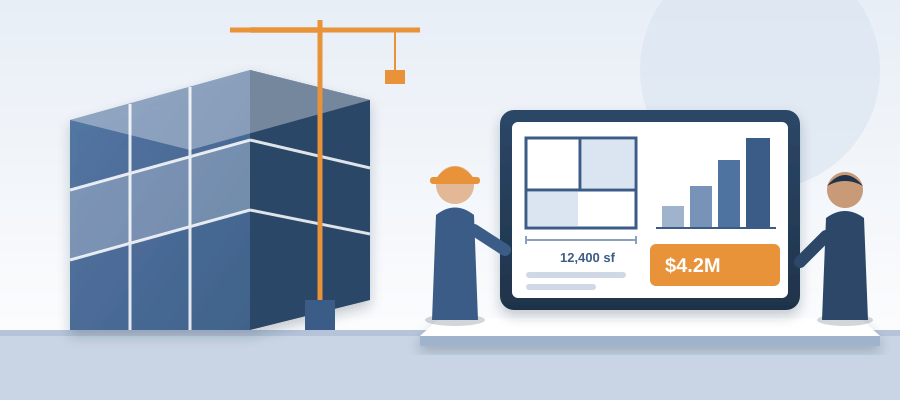
The fix is not a faster takeoff. The fix is having labor, material, and equipment cost riding on the geometry in the room, updating while people watch. That is how BidLight works inside Revit. One live record of the project, cost attached to the model, so when the design moves, the number moves with it.
That changes the meeting. You stop being the person who owes a number and become the person who can answer the question. That is a different seat at the table, and it is the seat where early estimates turn into something you can bill for.
What Happens When the Number Arrives Three Days Late
A deferred number does not just inconvenience the client. It changes who owns the decision. If you leave the walkthrough without an answer, the client starts guessing. Guessing turns into a rough number in their head. By the time your PDF lands, they are comparing your estimate to a figure they invented in a parking lot, and nobody wins that comparison.
The internal cost is worse than it looks. The estimator who owns the follow-up has to reconstruct a conversation they did not attend. They get a marked-up drawing or a list of verbal changes, and they rebuild intent from fragments. Every one of those reconstructions is a place estimating errors creep in, and reducing cost estimating errors in AEC projects starts with removing the reconstruction step entirely.

There is a scheduling tax too. The person who can price the change is usually the busiest person in the firm. Putting that work behind a three-day queue means other bids slip, RFIs sit, and the same estimator becomes the bottleneck on everything. You pay for that in overtime and in work you decline because nobody had bandwidth.
The client reads all of this as responsiveness, whether or not it is fair. They do not see the queue. They see a firm that took three days to answer a question about one wall. Meanwhile the firm down the street came back the same afternoon with a number, and even if your number is better, theirs arrived first.
Speed is not a marketing claim here. It is the difference between shaping the scope while it is still soft and pricing a scope that has already hardened around somebody else's assumptions.
How AI Estimates Construction Costs Off the Live Model
People ask how AI estimates construction costs, and the honest answer is that it reads the same model your team already trusts. Two AI models inside BidLight read the geometry and the metadata attached to it, then classify each element into BOQ line items. That classification runs at 86% accuracy, which is high enough to price a room in a meeting and low enough that a human stays in the loop on final bids.

The part that makes it defensible is the pricing side. Classification alone gives you quantities, and quantities without current prices are just arithmetic. BidLight pulls live pricing from a database of roughly $30,000 of cost data plus Craftsman, 1Build, and RSMeans. When you select a wall, you see the line item and what it costs today, not what a spreadsheet said in a prior quarter.
The workflow is plain. You export the model, and BidLight returns labor, equipment, material, and time costs in minutes. Numbers come back in 15 minutes instead of 90 for a typical takeoff pass. Because the cost is attached to the model, the number updates in real time when the design changes, so the walkthrough becomes a sequence of answers rather than a list of follow-ups.
AEC machine learning cost prediction is only useful when it keeps a human's judgment in the driver's seat. The model proposes the classification and the price. Your estimator decides what the assembly really is, what the site conditions add, and where the risk lives. That division of labor is what makes 86% accuracy an asset instead of a liability.
This is also where value engineering with BIM models gets practical. Instead of guessing which alternative is cheaper, you swap the assembly in the model and watch the cost move on screen. The comparison takes a minute, in front of the client, with the same geometry they are looking at.

Running the Walkthrough So the Estimate Does the Work
You do not need new meeting skills to make this work. You need the cost panel open next to the model from the first minute, and you need to select elements out loud as the conversation moves. When the client asks about the wider corridor, you click the corridor. The line item is there. You read it, you note what it excludes, and the conversation continues instead of pausing.
Set expectations early by telling the client what they will see. Say the number on screen is a working estimate against a live price database, and that the bid number gets reviewed before submission. That framing protects you and it gives the client something better than a promise. They get a figure now, with the caveat stated plainly, instead of silence for three days.
The real leverage shows up in the second half of the meeting. Once the client sees the cost respond to the model, they start asking better questions. What if we move this wall instead. What if we keep the layout and downgrade the finish. Each of those becomes a thirty-second model edit and a fresh number. That is value engineering happening live, not in a workshop three weeks later after the design is locked.
This is also where understanding the audience matters. Understanding what your audience is saying has a direct analogue in a walkthrough. If you know what the client actually cares about, cost certainty or schedule or disruption to operations, you aim the live model work at that concern. The same tool reads differently to a facilities director and a developer, and reducing customer churn using conversation insights applies here too. Clients who watch their questions get answered in the room do not shop the next project around.

End the meeting by sending the estimate. Not a note that says one is coming. The actual line items, out of the same model they just watched. The meeting and the deliverable are the same artifact, and that is the whole point.
Turning the Live Estimate Into a Service You Charge For
Most firms treat this capability as a favor. They price early estimates into overhead, absorb the hours, and hope the relationship pays it back on the next project. That math worked when the answers were slow and infrequent. It stops working when you can produce a number in a walkthrough, because now the client asks for it every time.
BidLight adds a cost model of its own, which makes the decision straightforward. Plans run from Basics at $260 per licence per year to Max at $590, with custom Enterprise pricing beyond that. Against the hourly cost of the estimator time it returns, the break-even is not a hard argument to make, and firms have reported saving on the order of 18,000 hours across their estimating work.
Once the number is fast, it becomes a billable service. Some firms package it as early cost advisory, a flat monthly fee for on-call pricing during design. Others fold it into preconstruction and count the walkthrough meetings as deliverables. The client gets something specific: a defensible number when they ask, priced against current market data, traceable back to the model.

Defensibility is the part clients pay for. When a number comes out of a model with named line items and a current price source, it survives scrutiny. If the client's board asks where $412,000 came from, you can show the assemblies, the quantities, and the source. That is a different conversation than explaining a spreadsheet somebody updated last month.
If you run an AEC firm and you want to stop absorbing estimating hours as overhead, the move is to put the model on screen in the next walkthrough and let the cost ride along with it. Own the record, own the number, and bill for the certainty you are already providing.