Missed Deadline Cost: The Model Record You Defended in the Interview
The Moment the Interview Turned
The question was simple. How do you keep a project coordinated when the design keeps moving? You said we move fast. Then you shared your screen and opened the folder: a dozen markups, three exports named "final", an email chain with the wrong revision attached. The room went quiet in a way you felt through the camera. The owner saw the file names. The two sets of initials. You had just told a story about control and shown them a system that cannot produce it without someone chasing updates by hand.
That is the missed deadline cost nobody puts in the budget. It is not the penalty clause. It is not the liquidated damages line the lawyer circled. It is the job you did not win because the record on your screen contradicted the sentence that came out of your mouth. Firms lose work that way every week and never book it as a loss.

The scattered folder is not a moral failing. It is the honest product of how most teams still coordinate. Someone exports the model, someone else marks up a PDF, a third person replies on Teams, and the issue lives in four places. It worked. It just did not work fast, and it did not stay true once the design moved. The interviewer was not asking about your character. They were asking whether your project record can survive a design change on a Thursday afternoon.
The fix is not a better speech. It is a different record. One live record of the project inside Revit and Navisworks, every export versioned, every issue pinned to the element it concerns. When you open your screen you are showing the project itself, not a snapshot of it. That is the difference between claiming control and demonstrating it in four clicks.
What the Scattered Record Actually Costs You
Start with the hours. Teams lose about 11 hours a week working out which model version is current. Most of that time is not judgment. It is opening files, comparing sheets, asking who has the latest, and rebuilding the picture when the architect sends a revised set. When every export is a versioned snapshot with its own files, author and milestone, the question "which one is current" stops being a job.
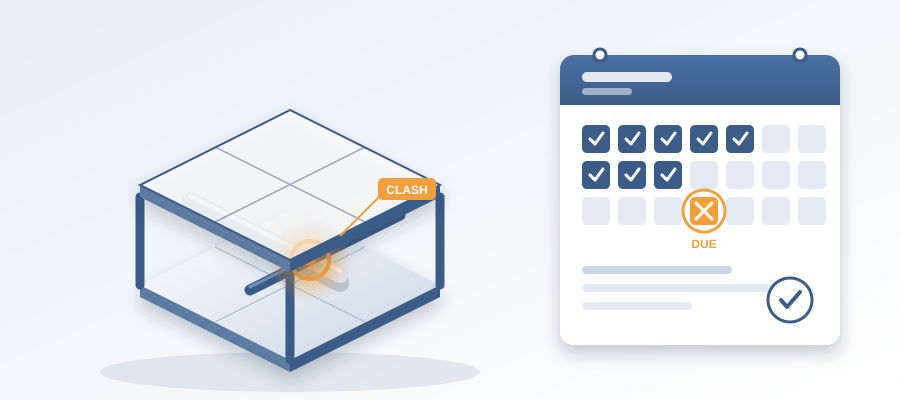
Then add the rework. The design changes, someone updates the model, and the people downstream do not know. Two weeks later a coordinator finds the gap on site and the crew stands around while the fix gets sorted out. A clash that sits unresolved can burn $15K to $50K a week in idle field labor. One that sat 47 days cost $28,000. That is not a rounding error. That is a line the schedule pays and nobody approved.

Now the part that hurts most: the job you lost. Not because you were expensive, but because you could not show control while the design was still warm. The owner wanted to see that a change in the model shows up as a change on the record, with a name against it. If the record lives in email, they know every change order will be a fight, every RFI will cost them a week, and every status meeting will start with an apology. If it lives on the model, they get a partner who can answer the phone with a fact instead of a promise to circle back.
So the missed deadline cost is not one line. It is the hours, the rework, and the work you never saw. Put those together and the scattered record is the most expensive thing your team produces each quarter. It just never appears on an invoice, which is why nobody escalates it.
How a Live Model Record Changes the Conversation
Here is the plain version of what BidLight does, because the mechanics matter if you are going to defend them. One live record of the project lives inside Revit and Navisworks. You publish straight from the model and each publish becomes a versioned snapshot with its own files, author and milestone. Any two revisions compare element by element, grouped by category: structural, MEP, envelope, interior. There is no second file, no overnight reconciliation, no coordinator rebuilding the picture on a Saturday.
What used to be a 90-minute meeting becomes about 15 minutes. You open the comparison, you see what moved, and you see who owns each piece. When the owner asks what happens if we move this wall, you show them which elements in the model it touches and which issues are already open against them. The answer is on the screen, not in a follow-up email.

Issues are pinned to the elements they concern and carry the sheet and revision they came from. Closing one is gated. It needs a screenshot, a tagged user and the model commit that fixed it. So when the owner asks about a problem that was "resolved," you can open the proof. That is what makes a closed issue mean something, and it is the difference between a record and a story.
That same live record makes the interview question easy next time. You do not describe your process. You open the project, pick two revisions and compare them. The changes appear, element by element. The client sees it happen. Whatever you said about moving fast is now beside the point, because they watched it.
It also changes what your coordinators do. They stop being file clerks who chase updates and become the people who know which change needs a second look. A daily 6am digest tells every owner what they own, so nobody has to be chased. That is the role they were hired for and the one they will stay for.

The Record You Get to Defend Later
Missed deadlines have a second act. First you lose the job. Then, if you win it anyway, you spend the project explaining why things moved. The change order arrives three weeks after the design changed because nobody connected the two, and now you are negotiating from a position where you look reactive. A versioned model record kills that conversation before it starts, because every change has a path back to the revision that introduced it.
This is where the workflow earns its keep beyond the pitch. Owners and general contractors are starting to ask whether your coordination can be traced. Not in a hostile way, just as a professional expectation, the same way they expect a schedule that reflects the actual sequence. When you can show that an issue was raised against a specific element, that the revision is on record, and that the fix was proven against a model commit, you stop arguing about intent and start agreeing about scope. That is a very different meeting.
It also shows who is behind while there is still time to do something about it. The project view lays every open issue against its owner. You walk into the weekly meeting knowing which trade is late, not finding out three weeks after the slip started. For the owner, that is the clearest signal that you are in control.
None of this requires you to abandon your current tools on day one. It requires you to stop treating email and markups as the system of record. Keep them for what they are good at. Let the model carry the history, so the story you defend six months from now is the one you showed in the interview, just updated to the design that actually exists.

The missed deadline cost is real, and most of it is invisible. The hours, the rework and the jobs you never knew you were losing do not show up in a ledger. They show up as a firm that works hard and stays flat. The fix is not a better pitch. It is a record that proves the pitch without you having to say a word.
What to Do Before the Next Interview
Pick one project and run it both ways. Reconstruct the last design change from email and markups, then open the same change as a comparison between two published revisions and compare the time. The gap will be large enough that you will not need to argue about it internally. It is also the safest way to introduce the change to a team that has been burned by software promises before, because it does not ask anyone to believe a claim.
Then rehearse the demo. Not the slides. The actual motion of publishing a revision, comparing it with the last one, opening an issue pinned to an element and closing it with proof. That is the three-minute version of your answer to how you keep a job coordinated, and it is more convincing than any case study you could send afterward. The interviewer is not testing your vocabulary. They are testing whether the record on your screen is alive.
Finally, decide who owns the model. A live record only stays live if the publishing habit holds, and that is a discipline, not a feature. Someone on your team needs to own the rhythm of publishes and the review of the digest. Once that person exists, the rest of the workflow is just habit. If you want to try this on your own project, plans run from Basics at $260 per licence per year to Max at $590, with custom Enterprise pricing for larger teams, and unlimited projects on every plan. There is also a done-for-you BIM side if you would rather have execution plans, 4D sequencing and fabrication detailing handled by people who do it all day.

Start with the smallest thing that would have changed the interview. Open the project. Compare two revisions. Watch the changes appear. If that does not land with the person on the other side of the table, nothing else you say was going to either.