From 40 Hours to 2: The Hidden Cost of Model Handoffs
The Nightmare of the Model Handoff
When the BIM manager exports a model for the estimator, it's never clean. Missing parameters, unclassified geometry, orphaned elements—every handoff carries a hidden tax of rework. You spend hours mapping materials, fixing hierarchies, and deciding what to count. That tax isn't in your bid; it's in your billable hours. And it's the single biggest drain on estimating productivity.
The problem is structural. BIM managers optimize for coordination and design intent; estimators need cost-ready data. The gap between those two worlds is a 40-hour cleanup. On a typical mid-rise project, you'll manually reclassify hundreds of elements, reconcile conflicting naming conventions, and rebuild quantity takeoffs from scratch. The model is a goldmine—but you have to dig through mud to get the nuggets.

The worst part? The work is invisible. Clients don't see the hours you spend cleaning; they see a number. And when the design changes, you do it all over again. The cost of handoff isn't a project expense—it's a recurring tax on every estimate. Machine learning construction cost prediction offers a way out: an AI that reads the model as it is, right now, without cleanup.
How AI Cost Estimation for Construction Eliminates Handoff Rework
BidLight lives inside Revit, so there's no export-import cycle. Your estimate is a live reading of the current model state. Two AI models parse geometry and metadata to classify BOQ line items at 86% accuracy. The moment the architect moves a wall or changes a material, your cost numbers update. No export. No cleanup. No 'close enough.'

Consider what that does to your workflow. Instead of spending two days cleaning a model, you spend two hours validating the AI's classification. The AI flags items it's unsure about, and you decide. You're no longer a data janitor—you're a decision-maker. That's the difference between bidding four jobs a month and bidding ten, because you're not burning 40 hours on every handoff.
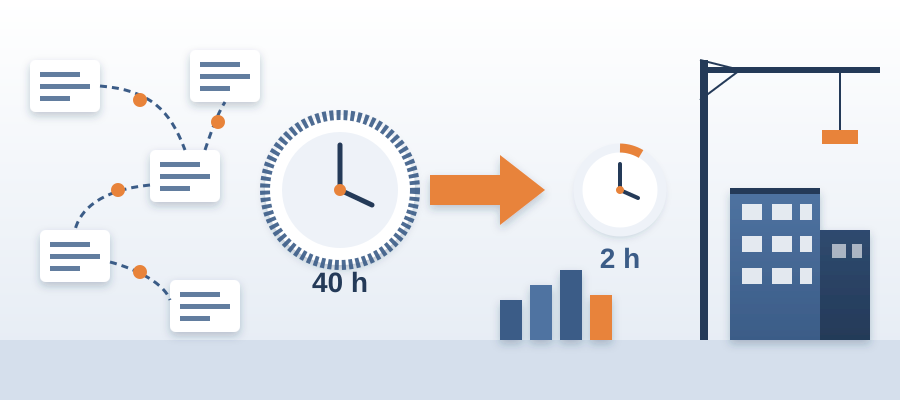
On a typical commercial project, that takes the model-to-estimate pipeline from 40 hours of cleanup to a 2-hour validation. That's 38 hours of reclaimed time per estimate—time that can go to more bids, deeper cost analysis, or earlier client engagement. AI cost estimation for construction doesn't just speed up takeoff; it changes the economics of bidding.
BIM Quantity Takeoff from Revit Model: Accuracy Without Cleanup
A key capability of machine learning construction cost prediction is the ability to handle messy models. BIM quantity takeoff from Revit model using BidLight doesn't require perfectly structured data. The AI is trained to recognize materials, assemblies, and quantities even when parameters are missing or inconsistent. It's not magic; it reads geometry and metadata together, so one weak parameter doesn't sink the classification.

For example, a Revit family might have a generic 'Width' parameter instead of a 'Door Width' parameter. Traditional takeoff software would miss it. BidLight's AI reads the geometry and metadata to infer it's a door, then pulls the width from the available data. It doesn't need perfect input to produce reliable output. That's how AI estimates construction costs in practice: by being resilient to real-world model quality.
This resilience is critical. Every project has quirks: a renamed wall type, an unhosted window, a structural element placed in an architectural category. Instead of spending hours hunting down these anomalies, the AI handles them. You validate the outliers. The result is a takeoff that's accurate enough to bid on, produced in a fraction of the time.

From Cleanup to Validation: A 5D BIM Cost Estimation Workflow
The 5D BIM cost estimation workflow traditionally demands a 'clean' model before any cost work can begin. That's the bottleneck. BidLight inverts the process: cost estimation happens alongside the model, not after it. The AI continuously updates quantities and costs as the design evolves. Handoff becomes a milestone, not a crisis.
Here's how it works on a typical project. The BIM manager completes a design iteration. Instead of exporting a model and sending a zip file, they simply note that the model is ready in Revit. The estimator opens BidLight, selects the appropriate database (BidLight's own pricing database, which costs roughly $30,000 a year to maintain, plus Craftsman, 1Build, and RSMeans), and runs the AI. Within minutes, they have a preliminary cost estimate. The remaining hours are spent validating classifications and adjusting assumptions.
This workflow changes the relationship between design and estimating. Designers no longer fear the estimator's questions; estimators no longer dread model updates. The 5D BIM cost estimation workflow becomes a feedback loop, not a handoff. And because BidLight integrates with Revit natively, the cost estimate is always current. When the architect makes a change, the estimate updates in real time. No re-export, no re-cleanup.

Making the Switch: What It Means for Your Firm
Adopting AEC machine learning cost prediction isn't just about speed; it's about capacity. When cleanup drops from days to hours, one estimator can cover far more bids. That changes who you can hire, how many bids you can chase, and how early you can engage with clients. Instead of waiting until design development for a cost check, you can provide schematic estimates as a billable service.
BidLight is priced per license, billed annually or monthly: Basics at $260 a year ($30/month), Core at $330 ($39/month), Complete at $440 ($51/month) and Max at $590 ($69/month), with custom Enterprise pricing. Every plan includes unlimited projects, and AIA members get discounts of up to 29%. For most firms, the time savings cover the license quickly.

Make no mistake: the model handoff has been a hidden cost in every construction project for decades. Machine learning construction cost prediction doesn't just reduce that cost—it eliminates it. You stop spending 40 hours cleaning models and start spending 2 hours validating them. The numbers you produce are defensible because they're rooted in the current model, not a cleaned version from last week. And the time you reclaim is the time you need to win more work.