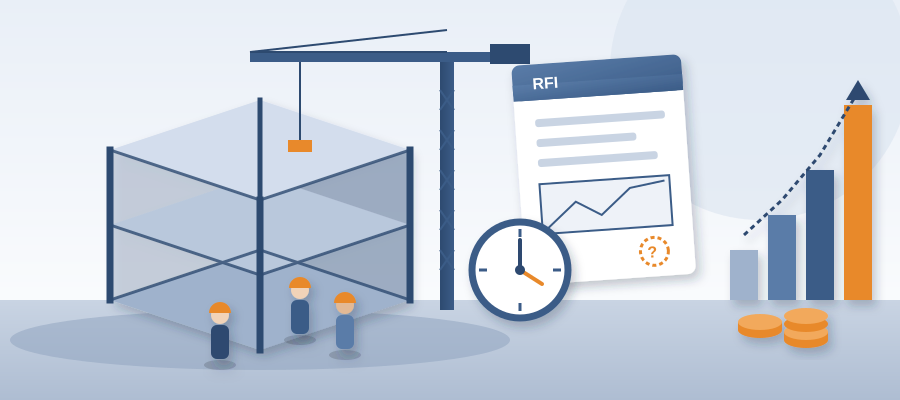
Every Late RFI Answer Is an Idle Field Labor Bill
The Money Leaves When the Crew Stops, Not When the Question Arrives
Six days. Two trades on standby. One question about a sleeve location that the model already answered.
That is the shape of the problem. An RFI gets written, logged, routed, answered, closed, and archived, and somewhere in that paperwork chain a crew stands on a deck with nothing to do. The person who wrote the RFI did their job. The person who answered it did their job in 20 minutes. The gap between that answer and the field is where the money goes.
Most firms track RFIs as a documentation metric. Open count, average response time, overdue list. Useful for the log, worthless for the payroll. The cost is not in the document. It is in the hours a crew burns standing next to material they cannot install because nobody told them which way the sleeve goes. That number never shows up next to the RFI because it lives in a different system, on a different report, owned by a different person.

Every late RFI answer is an idle field labor bill. Once you start reading it that way, the fix stops looking like a document management problem and starts looking like a cost problem. And cost problems are the ones you can actually price.
When I talk to superintendents about this, they do not describe it as an RFI problem. They describe it as a Tuesday problem. Two guys in the wrong place, a foreman on the phone, a crane window sliding. They already know the math. They just do not get to write it down where the estimator will see it.
What Six Days of Standby Actually Costs You
Take a two-trade standby on a commercial job. Two crews, four to six people between them, a lift and a foreman. Run that out for six days against loaded labor rates and you are not talking about a rounding error. You are talking about a number that would have shown up in a bid review and gotten flagged.
And you pay it whether or not you see it. Payroll runs Tuesday. The lift sits on rent. The general conditions keep ticking. None of those line items say the word RFI on them, so nobody connects the cost back to the question that sat in a queue for a week. The expense gets absorbed into labor variance and everybody shrugs at the end of the month.

The worse version is the compounding one. When the answer finally lands, the crew is already on another floor or another job. Now you have a mobilization cost stacked on top of the standby, plus a schedule float hit you may not recover. One sleeve location, answered late, can walk a sequence backward by two weeks.
Here is the part that stings. Your sub answered it in 20 minutes. The knowledge existed, was written down, and was correct. The six days were pure transit time. You paid for a question moving through people, not for a question being solved.
If you want ai cost estimation for construction to be useful, this is the kind of cost it has to see. Not just the concrete and the conduit, but the idle time your sequencing created. Those hours are as real as the rebar.
The Answer Was Already in the Model
The sleeve location lives in the model. It has coordinates, a host wall, an elevation, a size, and a revision number. When the fabricator asks where it goes, the model answers. It always did. The issue was never a knowledge gap, it was a routing gap. The question went into a system that had no contact with the geometry.

BidLight keeps one live record of the project inside Revit and Navisworks. That means the answer and the question live in the same place. Every issue gets pinned to the geometry it concerns, so when you open the sleeve detail you see the coordination note, the trade, the status, and the person who owns it. Not a PDF attachment in a thread. Not a screenshot in an email. The geometry and the decision, together, current as of the last commit.
When the design moves, the record moves with it. Change the sleeve location and the pin travels with the model. The commitment that was tracked against the old geometry gets flagged against the new one. You do not need a tracker to tell you something changed. The model tells you, because the cost is riding on the same model.
That is what people mean when they ask how does ai estimate construction costs and get a vague answer. The useful version is not a chatbot guessing at square footage. It is a system where the object, the quantity, the price, and the open question all resolve to the same geometry. Two AI models read the geometry and metadata and classify BOQ line items at 86% accuracy, pulling current pricing from a roughly $30,000 database plus Craftsman, 1Build, and RSMeans. When an RFI touches a classified object, the cost impact is already attached.
So the next time a foreman asks which way the sleeve goes, the answer is not a document to be chased. It is a location in the model that someone can open, with the cost consequence sitting right next to it.
Why the 6am Digest Beats the Inbox
Inboxes are where answers go to wait. The person who owns the sleeve question is not refreshing a portal. They are walking a job, running a crew, or on the phone with a supplier. If the answer requires them to log in somewhere, it waits. That waiting is the bill.

The 6am digest puts the open items in front of the person who owns them, before the shift starts. Not a notification that something happened. A short list of what is blocking work today, what changed overnight, and what needs a decision before the crew mobilizes. By the time the foreman is on site, the list is already in their hand.
This is the difference between a documentation system and a cost system. A documentation system is satisfied when the RFI is closed. A cost system is satisfied when the field knows the answer before the standby starts. Same question, different finish line, and the second one is the one that shows up in your labor variance.
Pair that with a live model and the loop closes fast. Someone answers at 4pm. The digest carries it at 6am. The crew starts with the current geometry and the current cost attached. That is a 14-hour turnaround on a question that used to take six days, and nobody had to chase a single email to make it happen.
You do not need a culture change to get there. You need the answer to land in the same place the work lives. For most firms that is Revit and Navisworks, not a third-party log. The shorter the distance between the decision and the geometry, the fewer hours you pay for nothing.

What This Changes About Your Estimate
Once RFI answers attach to the geometry, your estimate stops being a snapshot. The 5d bim cost estimation workflow people keep describing in slide decks is really just this. Quantities come off the model, prices come from current data, and the open questions ride along with the objects they touch. Change the sleeve, and you see what it costs before anyone orders material.
BidLight exports labor, equipment, material, and time costs in minutes, and the number updates in real time when the design changes. That matters here because so many RFI answers ARE design changes. The sub does not just answer the question, they resolve it, and resolution moves quantities. If your estimate is a file on someone's desktop, that movement is invisible until bid day. If your estimate is riding the model, it is visible at 6am with the rest of the digest.
This is also where aec machine learning cost prediction earns its keep. Not by replacing your estimator's judgment, but by keeping the classification and pricing current while the design churns. 86% accuracy on BOQ line items, tied to a database that reflects today's pricing, is a far better starting point than a spreadsheet from three quarters ago. Your estimator spends their time on the 14% that needs a human call, not on re-keying quantities that the model already knows.
And it makes the early estimate a billable service. When a client asks what a layout change costs, you can answer in the meeting. You are not selling software, you are selling the ability to say a number out loud and defend it. That is a service line you can price, and it is the same model you already built.

Plans run from Basics at $260 per licence per year to Max at $590, with custom Enterprise pricing. If you would rather not run it yourself, BidLight does done-for-you BIM work, including execution plans, 4D and 5D, and fabrication detailing. Either way, the field stops waiting on paper.
If you have been searching construction cost estimating software free download hoping a spreadsheet template would close the gap, this is the honest version. The gap was never the pricing table. It was the distance between the answer and the crew. Close that distance and the standby hours come back to you as margin.