Idle Crews Wait on a Clash the Model Already Solved
The Day the Crew Stood Still
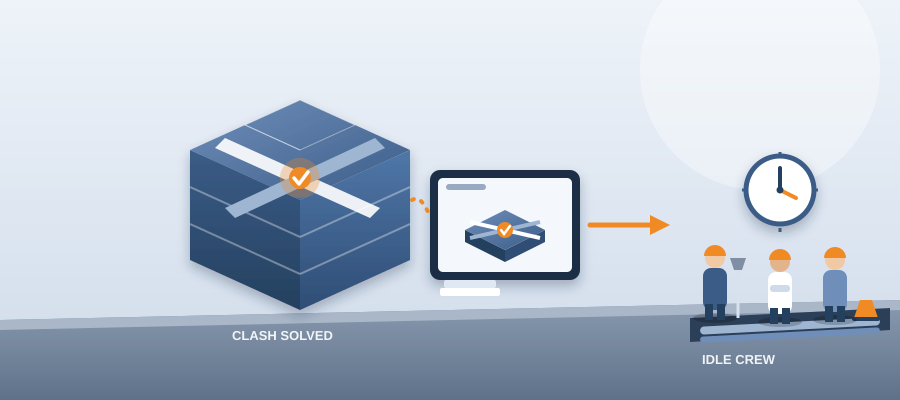
The MEP crew shows up on level three. Tools ready. The area is blocked. A clash between a duct and a beam was flagged two days ago and nobody told the field it was fixed. The foreman waits for a call. The crew waits for the foreman. The hours go. That is $15K to $50K a week in idle field labour sitting behind an unresolved clash.
The clash was fixed in the model days earlier. The BIM coordinator resolved it, closed the issue, moved on. The field never got the memo. The model answer stayed in the model. That is not a coordination failure. It is a communication failure, and it is what BidLight is built to stop.

BidLight keeps one live record of the project inside Revit and Navisworks. Every export is versioned and compared element by element. You see what changed in about 15 minutes instead of a 90-minute meeting. When an issue is closed it carries a screenshot, a tagged user and the model commit that fixed it. The field can see not just that a clash is resolved, but how and when. The 6am digest tells every owner what they own. The project view shows who is behind while there is still schedule left to move work.
So why did the crew stand idle? The model answer never reached them. More meetings will not fix that. Putting the model answer in front of the field before they mobilize will. BidLight makes the model the live record and pushes the update to the people who need it.
The cost is not just wages. It is schedule slip, the ripple on other trades, the overtime to catch up. A clash caught in the model costs about $50 to fix. The same clash found in the field costs $5,000 to $50,000. A clash that is resolved but never communicated can burn $15K to $50K a week in idle field labour. That is the number worth sitting up for.
The crew standing by is not hypothetical. It happens on jobs every week. It is preventable. With BidLight every issue pins to the element it concerns and closes only with proof. The field can see that proof before they mobilize. Then they get to work.

Why Resolved Clashes Still Stop Work
A closed issue in the model is not a closed issue in the field. The field does not live in Revit. They live with materials and schedules. They work from drawings, RFIs and word of mouth. If the model changes and nobody tells them, they work off old information. That is how a resolved clash becomes an idle crew.
Traditional coordination runs on meetings, emails and PDFs. A clash is discussed, resolved, minutes go out. The field may not see those minutes for days. They may not see the implication. The drawing in their hand may still be the old one. The model has moved on. The field has not. That gap is where idle labour lives.
BidLight closes the gap. Every export is versioned and diffed element by element, so a change is visible. Issues pin to the element they concern, so there is no ambiguity about what was fixed. Closing an issue is gated: a screenshot, a tagged user, a linked model commit. The field can trust that a closed issue is closed. They can see the proof.
The 6am digest puts the model answer in front of the field. Every morning each owner gets what they own, what is open, what is closed. Field foremen included. They know before they mobilize what is resolved and what is not. No more waiting for a call that never comes.

The project view shows every issue against its owner. If a crew is waiting, you can see why. The issue is still open, or it is closed and not communicated. Either way you can act before the idle labour burns another day. That cost is too high to leave to chance.
In coordination, the real cost control comes from avoiding rework and idle labour, not from a number on a page. A model that is coordinated and communicated saves money on the job. That is what BidLight delivers: solve it in the model, not in the field. The crew is not standing by while the block is already solved in the model.
The BidLight Fix: Model Answers Before Mobilization
BidLight puts the model answer in front of the field before they mobilize. The model becomes the live record and the update goes to the people who need it. The 6am digest is a key part. It tells every owner what they own, field included. When a clash is resolved, the foreman knows before the crew starts. No more idle waiting.
The digest is one piece. The project view shows every issue against its owner, so you can see who is behind and what is blocking work. If a crew is waiting on a clash, you can see if the issue is closed. If it is closed, you can see the proof: the screenshot, the tagged user, the model commit. That proof gives the field confidence to proceed. They are not guessing. They work from a verified answer.

The versioned exports and element-level diffs are the backbone. Every export is compared to the previous version. Changes are highlighted by category: structural, MEP, envelope, interior. The field sees exactly what changed and where. A duct rerouted to avoid a clash shows up. A beam shifted shows up. That detail is what prevents idle labour.
BidLight closes the loop on issue resolution. An issue closes only with a screenshot, a tagged user and a linked model commit. The same problem does not come back on site. The field can trust a closed issue is done. The proof is attached, so there is no debate. The model is the live record.
The result is fewer idle hours, less rework, a schedule that holds. The $15K to $50K a week in idle labour is avoided. The $5,000 to $50,000 per clash in the field is avoided. The about $50 to fix it in the model is all you pay. That is coordination done right.
That is the real cost control on a job. A number on a page does not prevent idle labour that blows the budget. BidLight does. It keeps the project moving and the crew working. That is what every general contractor and trade contractor needs.

What This Means for Your Next Job
If you are a BIM coordinator, you know the pain of chasing updates. You know the frustration of resolving a clash only to find the field never got the message. BidLight removes that pain. The model becomes the live record. The answers go in front of the people who need them. You spend less time in meetings and more time coordinating. Less time answering the same question, more time solving real problems.
If you are a project manager, you care about schedule and cost. Idle labour hits both. BidLight gives you visibility into who is behind and what is blocking work. The project view shows every issue against its owner, so you can act before the slip becomes a crisis. The 6am digest keeps everyone accountable without you chasing. That is how you protect your margin.
If you are a field foreman, you want to know what to do and when. You do not want to stand around waiting for a call. BidLight gives you the answer before you mobilize. The 6am digest tells you what is resolved and what is not. The proof is attached, so you can trust it. You plan your day and keep your crew working.
The numbers: $15K to $50K a week in idle labour avoided. $5,000 to $50,000 per clash avoided. 11 hours a week per coordinator saved working out which model version is current. Real savings on real jobs. It comes from one shift: put the model answer in front of the field before they mobilize. BidLight makes that shift possible.

So the next time a crew is waiting, ask why. Is the clash still open? Or is it closed and not communicated? With BidLight the answer is clear. The model is the live record and the field has access to it. No more idle crews. No more wasted weeks. Just work getting done.