Coordination Without a Diff: Why Screenshots Fail and What the Model Knows
The Meeting That Runs on Screenshots
You know the room. Laptops open, a projector throwing a Revit view onto the wall, and four people trying to agree on which file is the current one. Someone has a screenshot from Tuesday. Someone else has a PDF from Thursday. The MEP lead exported something Friday morning but nobody is sure if it includes the updated riser. For the first thirty minutes, the meeting is not about coordination. It is about archaeology.
Then comes the walk. Someone reads from a clash list that was generated two weeks ago. Item one: beam versus duct. The structural coordinator says that was fixed last week. Item two: sprinkler main versus cable tray. That one was resolved in a side conversation after the last meeting but never closed in the log. Item three: a wall penetration that is still open. By the time you reach an actual open issue, you have burned forty minutes and half the room is answering email.

None of this is anyone's fault. It is just what happens when the coordination record lives in screenshots, PDFs, and a shared drive with seventeen folders. The information exists. It is just scattered across tools that do not talk. The meeting becomes a manual reconciliation of all those scattered copies, and the actual work of sequencing and resolving clashes waits.
This is the daily reality for BIM and VDC managers, coordinators, and the trades who answer to them. You are not short on effort. You are short on a single source of truth that shows what changed since the last meeting. Without it, every meeting starts from zero, and the field pays for the confusion.
The cost is not just the hour and a half in the room. It is the decisions that get delayed because the room cannot agree on the facts. It is the RFI that gets written because no one can confirm what the model says today. It is the crew that stands idle tomorrow because the clash that was supposedly closed is still open in the field. Solve the record and the meeting solves itself.
What a Real Diff Would Have Told You
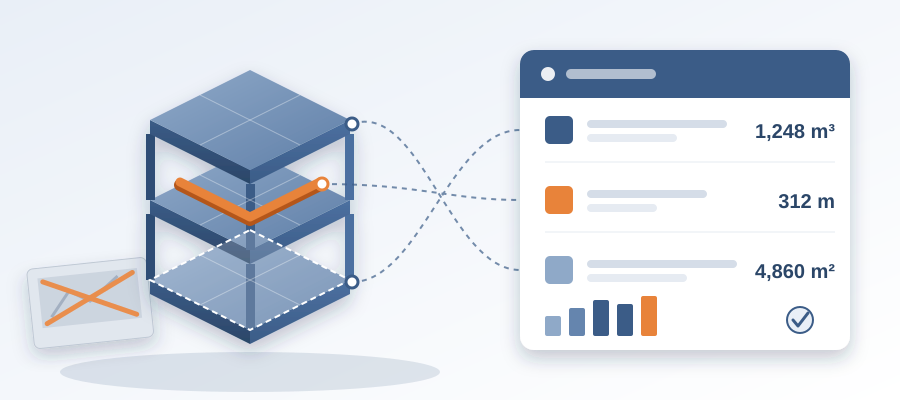
A diff is simple in concept. You take version 3 of the model and version 4, and you compare them element by element. Not a visual overlay. Not a PDF comparison. A line-by-line accounting of what moved, what was added, what was deleted, and which category it belongs to: structural, MEP, envelope, interior. You see that the sprinkler main shifted six inches east, that three new sleeves were cut in a shear wall, that the ceiling grid was raised in two rooms, and that a duct that was previously clashing is now clear.

With BidLight, every export is versioned and diffed at the element level. You do not guess which file is current because the record shows it. You do not argue about whether a clash was fixed because the diff shows the element moved and the issue closed against the model commit that fixed it. The answer takes about 15 minutes instead of a 90-minute meeting. That is not a small time saving. It is the difference between a meeting that produces decisions and a meeting that produces another meeting.
That same element-level record is what makes a revit quantity takeoff from revit model reliable. When you pull quantities for a package, you need to know which version you are pulling from. If you are not sure whether the export you are using includes last week's changes, your quantities are a guess. With a versioned record, you know exactly what is in the model at the moment you pull. You can trace every change that affected the count. That takes the guesswork out of the workflow and cuts the hours spent reconciling versions.
The 11 hours a week that teams lose working out which model version is current is not a rounding error. It is a full workday plus. That time comes back to you when the diff is automatic and the record is live. And when you move from takeoff to coordination, the same logic applies. Clash detection services for Revit models and BIM coordination services for MEP contractors both start with the same question: what changed since the last time we looked? The diff answers it before the meeting starts.
The field cost is where the real number shows up. A clash caught in the model costs about $50 to fix. The same clash found in the field costs $5,000 to $50,000. And an unresolved clash can burn $15K to $50K a week in idle field labor while crews wait for a decision. Those numbers are not abstract. They are the reason a 15-minute diff is worth more than a 90-minute meeting. The meeting is where the money gets spent. The diff is where it gets saved.

From Diff to Done: Gated Closure and the 6am Digest
A diff tells you what changed. But coordination is not finished until the issue is closed with proof. This is where most systems fall apart. An issue gets marked as resolved in someone's spreadsheet, but there is no screenshot, no tagged user, and no link to the model commit that fixed it. So the same clash shows up on site three weeks later, and the crew that was told it was fixed is now standing idle. The model record says it was fixed. The field knows better.
BidLight closes that loophole. An issue can only be closed with three things: a screenshot, a tagged user, and a linked model commit. That means the fix is proven, not promised. The screenshot shows what the model looks like after the fix. The tagged user is accountable. The model commit is the exact version where the fix lives. If someone asks why the duct is different now, you can point to the commit and the user. No more arguing about whether it was done. The record is the record.
That gated closure is what makes the 6am digest useful. Every morning, every owner gets a short list of what they own and what is still open. No one needs to chase. No one needs to ask for an update because the update is waiting in the inbox at 6am. If an issue is behind, everyone knows. The project view shows who is behind while there is still schedule left to recover. That is not about blame. It is about fixing the slip before it becomes a change order or a delay claim.
When you combine the diff with the digest, the coordination meeting changes character. You do not spend the first half hour confirming files because the diff already knows. You do not walk closed issues because the closure gate makes it impossible to fake a close. You spend the time on what is open: the clashes that need a decision, the changes that need coordination, the sequencing that needs attention. The meeting becomes about work instead of archaeology.

The cost case for this is straightforward. If you catch five clashes in the model that would have cost $5,000 to $50,000 in the field, you have saved between $25,000 and $250,000 on a single coordination cycle. That is not a projection. It is arithmetic based on the cost difference between solving in the model and solving in the field. And the idle field labor number is even more stark. An unresolved clash can tie up $15K to $50K a week in crews waiting for direction. The 6am digest and the project view are how you see that risk early enough to act.
What This Means for BIM and VDC Managers
If you are a BIM manager, a VDC manager, or a coordinator who runs these meetings, you know the frustration of chasing updates across Teams, email and Bluebeam. The diff does not eliminate the need for conversation, but it changes what the conversation is about. You stop being a human reconciliation engine and start being a coordinator. You stop spending your day confirming which file is current and start spending it on the parts of the job that need your judgment.
The same is true for project managers and the trades who answer to them. When the model record is live and the closure is gated, the field gets a reliable answer about what is resolved. The RFI count drops because the model answers the question. The change order count drops because the clash was caught before it became a field problem. The schedule holds because the crews are not waiting on unresolved conflicts. That is what it means to solve in the model instead of the field.
There is a broader point here about how coordination is changing. For a long time, bim vs traditional cost estimating in aec was a debate about methods. But the real difference is not the method. It is the quality of the record. A revit quantity takeoff to estimate workflow is only as good as the version control behind it. The 5d bim cost estimation workflow only works if the model is coordinated. You cannot build time and cost onto a model that is not a reliable record of what is going to be built. The diff is what makes the record reliable.

BidLight is not trying to be everything. It is focused on keeping one live record of the project inside Revit and Navisworks, on the model the team already works in. Every export is versioned. Every change is diffed. Every issue is pinned to the element it concerns and closes only with proof. That is the foundation. Everything else, from clash detection services for Revit models to coordination across trades, sits on top of that foundation.
What you get back is time and money. The hours lost reconciling versions come back. The idle labor behind unresolved clashes goes away or gets caught early. The meeting runs on a diff instead of screenshots. And the field gets a reliable answer about what is fixed and what is not. That is not a theoretical benefit. It is the difference between a coordination cycle that produces a coordinated model and one that produces a longer meeting next week.
The Takeaway
You do not have to accept the ninety-minute meeting. You do not have to spend the first half hour confirming which file is current. The diff already knows. It knows because every export is versioned and every change is compared element by element. That record is the thing that makes the meeting shorter, the field more predictable, and the cost of the job lower. It is not about better screenshots. It is about a live record that everyone can trust.
When you solve the clash in the model for about $50, you avoid the $5,000 to $50,000 field fix. When you close the issue with proof, it stays closed. When the 6am digest shows who is behind, you have time to act before the schedule slips. These are not promises. They are the mechanics of a system that keeps the record live and makes the record the answer. The meeting can be fifteen minutes. The record can be the room.

If your coordination meeting still runs on screenshots, start with the diff. Pick one cycle, version the exports, and compare them. See how much time you spend arguing about files versus deciding about work. The answer will tell you where to go next. The model already knows. Give it a chance to tell you.