Coordination Meeting Agenda: Start With the Diff, Not the Recap
The Recap Tax on Every Coordination Meeting
You know the drill. The meeting starts at 9. Someone is still opening a file. Someone else is asking which version is current. By 9:40 you have agreed on what changed since last week, and there are 20 minutes left to solve something. That is not a meeting. That is a group of people doing file archaeology on the clock. The cost is real: 11 hours a week lost across a team just working out which model version is current. Add the meeting time on top, and you have paid for a full day of coordination before anyone has made a decision.
The problem is not the people. It is the lack of a single record that diffs changes for you. When updates live in email threads, Teams channels and Bluebeam snapshots, the first job of every meeting is to rebuild state from fragments. That rebuild takes 40 minutes minimum, and it still ends with someone saying, I think this is the latest. You leave with action items based on a guess.

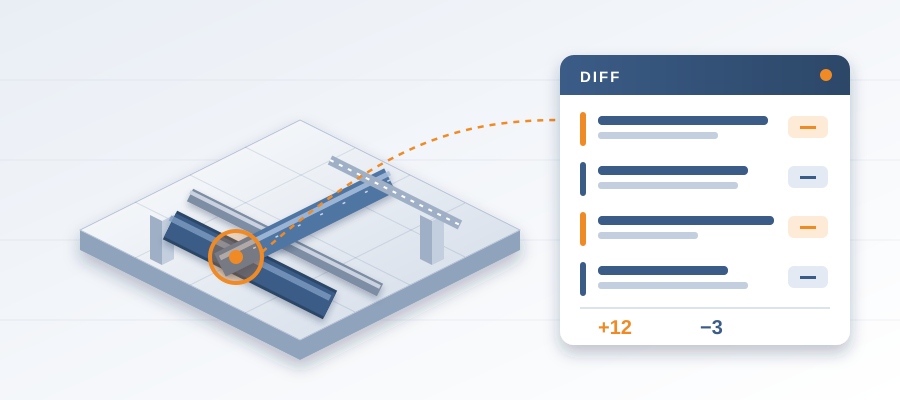
BidLight removes the rebuild. Every export is versioned and compared element by element, by category: structural, MEP, envelope, interior. The 6am digest lands in every owner's inbox with what changed, what is open and who owns it. The agenda is already written when you walk in. The meeting starts at the diff, not at the file browser.
That shift sounds small. It is not. It changes what the meeting is for. Instead of spending the first block establishing facts, you spend it deciding what to do about them. Clashes are already pinned to the element. Issues are already assigned. You open the project view and the first question is not what changed, it is what do we do about this clash on level 3. That is a meeting worth having.
For MEP contractors especially, the recap tax hits harder because your scope moves most. Duct reroutes, pipe offsets, hanger changes: every trade shift creates a new coordination question. If you are spending 40 minutes a week just finding out what moved, you are not coordinating, you are catching up. The fix is not a longer meeting. It is a better starting point.
What the 6am Digest Puts on the Table
The 6am digest is not a status report. It is the meeting pre-read that writes itself from the model record. It tells every owner what they own: open issues pinned to their elements, clashes that appeared since the last export, items that closed with proof and items that closed without it. You get a list of what is on your plate before you have had your coffee. No chasing. No asking around. No rebuilding state in the meeting.

The digest pulls from a versioned record. Every export is stored with a commit reference, and every issue carries the sheet and revision that raised it. When you open the digest and see a clash on a duct main, you can click through to the exact element in Navisworks and see the geometry that changed. You are not looking at a screenshot of a screenshot. You are looking at the model.
That matters for MEP coordination because clashes are rarely isolated. A moved duct main affects hangers, sprinkler lines, cable tray and ceiling grid. The digest shows the change in context, by category, so you see the chain before the meeting. You can flag the mechanical owner, the electrical owner and the ceiling contractor in one pass. When you sit down, everyone already knows why they are there.
The digest also makes ownership visible without a conversation. It includes per-person resolution rates, the Problem Solver Index, so you can see who is closing issues and who is sitting on them. You are not calling anyone out. The record is doing the talking. If a trade has 12 open issues and zero closures this week, that is on the screen at 6am, not a surprise at the meeting.

For BIM coordination services for MEP contractors, this is the difference between a meeting that manages the work and a meeting that manages the calendar. The digest puts the work in front of the right people early enough to act. The meeting becomes a review of decisions, not a discovery session.
The Agenda Item That Is Already Decided: Clash First, Then Cost
Here is the number that should shape every agenda: a clash caught in the model costs about $50 to fix. The same clash found in the field costs $5,000 to $50,000. And an unresolved clash can burn $15K to $50K a week in idle field labour while crews wait. That is the real agenda item. Every minute you spend on a recap is a minute you are not spending on a clash that is costing you a week of field time.
When the diff is already on the screen, the meeting can start with the highest-cost item: the clash that is blocking a crew. You do not need to find it. It is pinned to the element and sitting in the digest. You open the model, look at the geometry, and decide. Maybe it is a routing change. Maybe it is a hanger adjustment. Maybe it is a real conflict that needs a design clarification. Whatever it is, you are deciding it at 9:05 instead of 9:45.

That time shift has a compound effect. The earlier you decide, the earlier the fix goes into the model, the earlier the next export shows it resolved. The issue closes with a screenshot, a tagged user and the model commit that fixed it. That closure is proof. It does not come back on site. The same problem does not resurface in three weeks because someone forgot to update the fabrication package.
Cost control on the job is not a separate workstream. It is the direct result of solving problems in the model while they are still cheap. The meeting agenda that writes itself is the one that puts the $50 fix in front of the team before it becomes a $50,000 field problem. That is the whole point of coordination. The agenda just makes it visible.
This is also where value engineering with BIM models gets real. Value engineering is not a one-time workshop. It is a weekly habit of asking, what can we change in the model to avoid a field cost. When the diff is on the screen, that question is easy to ask. When you are still finding the file, it never gets asked.
What It Takes to Run the Meeting This Way
You do not need a new process. You need a record that diffs for you. BidLight runs inside Revit and Navisworks, on the model your team already works in. There is no separate portal to update and no second system of record. Every export is versioned and compared element by element, so the diff is a byproduct of normal coordination, not an extra task. That is what makes the 6am digest possible: the work is already done.

The gated closure is the other half. An issue does not close because someone says it is done. It closes with a screenshot, a tagged user and a linked model commit. That gives the next meeting a clean starting point. You are not reopening last week's items because someone closed them without proof. The record says what is fixed and what is not, and the diff shows the geometry that changed. The meeting agenda builds itself from that record.
For MEP contractors running BIM coordination services, this is how you keep the meeting short without losing the thread. The project view shows every issue against its owner. The digest shows what is new. The diff shows what changed. You walk in, open the project view, and start with the item that is costing the most. No recap. No file archaeology. No guessing.
And when the meeting is over, the record keeps working. The next export diffs against the last one. The next digest goes out at 6am. The cycle repeats without anyone rebuilding state by hand. That is how you get 15 minutes instead of a 90-minute meeting. Not by rushing. By starting from a record that already knows what changed.

The takeaway is simple. The first 40 minutes of your coordination meeting are a tax you pay for not having a diff. BidLight removes that tax. You start with the clash, you decide, you close with proof, and you leave with a schedule that still has room to move. The agenda writes itself because the model already wrote it.